



We’ve got this.
Colette Kress, interim chief executive of Nvidia, on the results call
Nvidia has just reported another quarter that beat every forecast. Its shares fell anyway, and they now trade more than 40% below their October high. The gap shows what investors are really paying for. The numbers are fine, but the leadership, the politics and the durability of the AI boom are not.
In short
- Revenue of $115.8bn beat forecasts by about 6%, and guidance of $130bn for next quarter beat them too.
- The shares have fallen every day since the results and are 43% below their October record. Most of that fall came before Jensen Huang resigned.
- Data centres now make up 93% of sales. Big cloud companies are still buying hard, but the other buyers, including debt-funded AI clouds, fell short of forecasts.
The beat goes on
Nvidia reported revenue of $115.8bn for the three months to 25 October (Nvidia, 17 Nov), up 103% on a year and 20% on the previous quarter (Nvidia, 17 Nov). Analysts had expected about $109bn: estimates ranged from $108.7bn (GamesBeat, 17 Nov) to $109.1bn (LSEG via CNBC, 17 Nov). That puts the beat at roughly 6% (calc. from Nvidia and LSEG, 17 Nov). Nvidia also cleared its own bar comfortably. In August it had guided to $108bn, plus or minus 2% (Nvidia, 26 Aug), and the result landed $5.6bn above the top of that range (calc. from Nvidia, 26 Aug and 17 Nov). Adjusted earnings per share were $2.68 (Nvidia, 17 Nov) against $2.48 expected (LSEG via CNBC, 17 Nov). Net income doubled to $65.3bn (Nvidia, 17 Nov). Even gross margin, the figure investors had worried about most, came in at 74.9% (Nvidia, 17 Nov) against an expected 74.0% (StreetAccount via CNBC, 17 Nov). It is the sixth quarter in a row in which Nvidia has beaten on both revenue and earnings (24/7 Wall St, 17 Nov).
The outlook was stronger still. Nvidia guided to $130bn for the current quarter, plus or minus 3% (Nvidia, 17 Nov), against a consensus of $125.25bn (LSEG via Finimize, 17 Nov). Even the bottom of the range, $126.1bn (calc. from Nvidia, 17 Nov), is above what analysts had pencilled in. Nvidia also raised its forecast for growth in fiscal 2028 to about 75% (Nvidia, 17 Nov), from 70% in August (Nvidia, 26 Aug). Two caveats keep the guidance honest. First, the quarter has an extra, fourteenth week (Nvidia, 17 Nov), which flatters the 12% step-up (calc. from Nvidia, 17 Nov); per week, revenue grows closer to 4% (calc. from Nvidia, 17 Nov). Second, gross margin is guided down to 71–72%, from 74.9% this quarter (Nvidia, 17 Nov), as rising memory costs bite. The forecast assumes no data centre revenue from China at all.
Exhibit 1
Six beats in a row
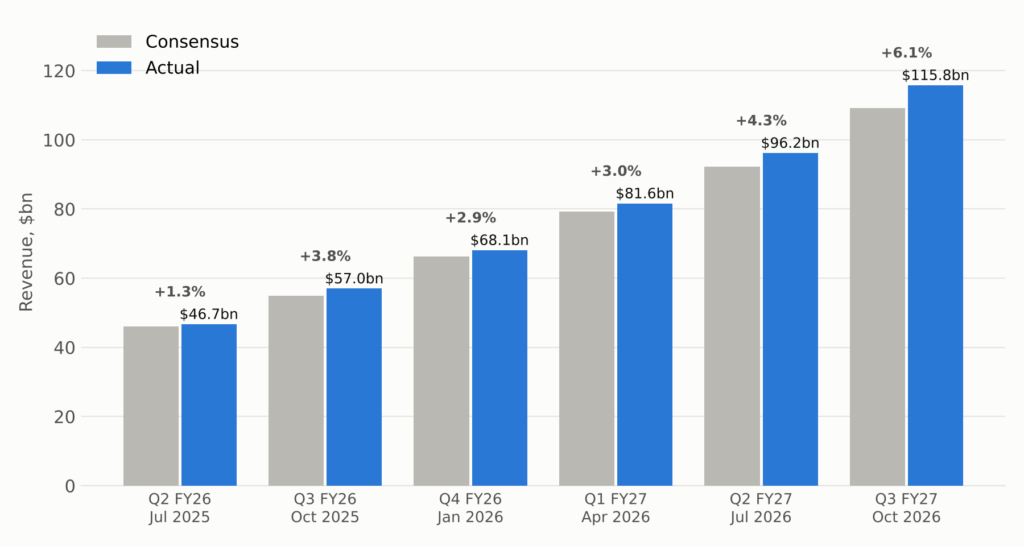
Exhibit 1: Nvidia quarterly revenue against analyst consensus, last six quarters, in USD bn. The percentage above each pair is the beat. Source: SGMS, based on Nvidia earnings releases and consensus from LSEG, Constellation Research and Kiplinger. Data compiled by Luzius Richter.
Sell the news
For a few hours the numbers did their job. Nvidia closed at $155.46 on Tuesday (Yahoo Finance, 17 Nov) and rose about 4.5% in after-hours trading to around $162 (Inc., 17 Nov). By Wednesday’s close the gain had gone: the stock opened at $159.19, then slid to $150.96, down 2.9% on the day (Yahoo Finance, 18 Nov). It did not help that minutes from the Federal Reserve’s October meeting, released the same afternoon, pointed towards a rate rise in December (Xinhua, 18 Nov). On Thursday the pattern repeated. Shares rose in early trading, then closed at $145.98, down 3.3% (Yahoo Finance, 19 Nov).
On Friday the selling deepened. By 13:17 New York time the shares were at $135.73, down 7.0% on the day (Yahoo Finance, 20 Nov), after California’s attorney general subpoenaed Nvidia and lawmakers opened a probe into whether its chips reached China and what investors were told (Yahoo Finance, 20 Nov). A weak second day for Anthropic’s newly listed shares cooled the wider AI trade (Motley Fool, 20 Nov). That leaves Nvidia down 16.7% on the week from last Friday’s close of $162.85 (calc. from Yahoo Finance, 13 and 20 Nov), and heading for a seventh straight daily loss (Motley Fool, 20 Nov). Against its record close of $239.24 on 6 October (Yahoo Finance, 6 Oct), it now trades 43% lower (calc. from Yahoo Finance, 6 Oct and 20 Nov). By Wednesday the fall had already wiped about $2tn off its market value (Bloomberg, 18 Nov). To get back to that high, the shares would have to rise by about 76% (calc. from Yahoo Finance, 6 Oct and 20 Nov).
Exhibit 2
Down 43% from the top
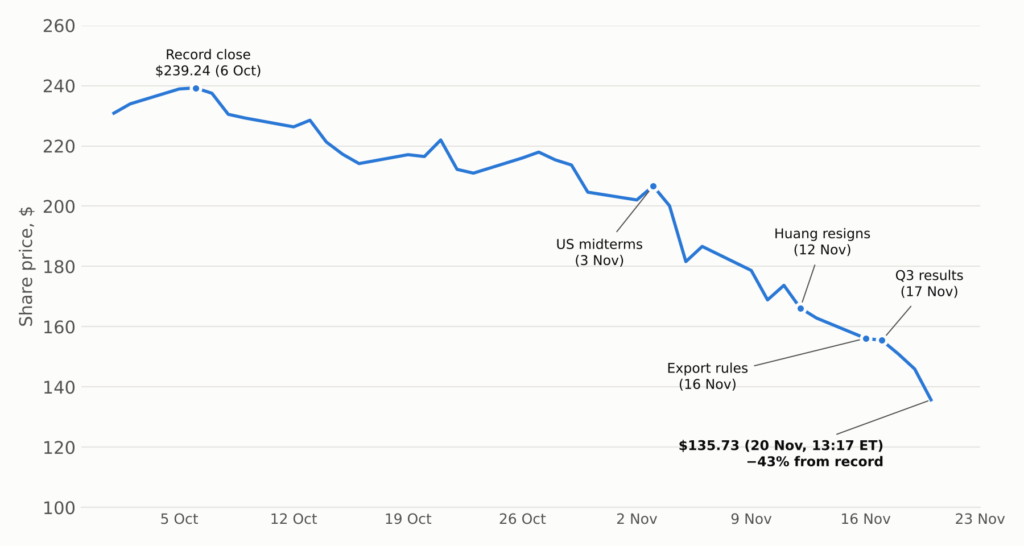
Exhibit 2: Nvidia share price since 1 October, in USD: daily closes, with the latest point at 13:17 New York time on 20 November. Key dates marked. Source: SGMS, based on Yahoo Finance price data. Data compiled by Luzius Richter.
Mind the discount
It is worth being precise about timing: most of the fall came before Huang left. By the close on 11 November the stock was already 27% below its October high (calc. from Yahoo Finance, 6 Oct and 11 Nov). A sell-off in chip stocks followed the 3 November midterms, in which Democrats won both chambers of Congress and investors began pricing in tougher AI rules and slower data centre spending (TIKR, 5 Nov). Nvidia lost 9.3% on 5 November alone (Yahoo Finance, 5 Nov). Rising rate expectations added to the pressure.
The leadership change came on top of that. Huang resigned on 12 November after reports of extramarital affairs, one of them with a woman alleged to be a Chinese spy. The stock fell as much as 14% that day before closing 4.3% lower (Yahoo Finance, 12 Nov). Colette Kress, CFO since 2013 (Nvidia, 12 Nov), became interim CEO while keeping her finance role, and Harvey Jones became the board’s first chair (Nvidia, 12 Nov). The board is searching inside and outside the company. Kress has now shown that the business can run without its founder for a quarter. What investors cannot yet price is who will set strategy for the next five years, when Huang himself was a large part of the investment case.
Four days later, on 16 November, the Commerce Department added a second overhang (BIS, 16 Nov). Its new rule requires export licences for advanced chips sent to Indonesia, Malaysia, Singapore, Thailand and Brazil. It also makes data centres vet their customers, so that Chinese firms cannot rent American computing power remotely (BIS, 16 Nov). Nvidia fell 4.1% that day (Yahoo Finance, 16 Nov). The direct exposure looks small: customers based outside the US, Taiwan and China made up about 1.3% of revenue last quarter (TECHi, 16 Nov). The worry is what the filings do not show. Taiwan-billed sales account for 28% of revenue (TECHi, 16 Nov), and nobody outside the company knows where those chips are finally installed.
The result is a stock that looks cheap on its own numbers. Before the results it traded at about 12 times forward earnings, the lowest multiple since 2012 (LSEG via Reuters, 12 Nov). The market is not doubting this quarter. It is demanding a discount for uncertainty about leadership, policy and how long the spending lasts.
Spending spree
Data centres are now almost the whole company. The segment brought in $107.6bn, up 110% on a year (Nvidia, 17 Nov) and about 93% of total revenue (calc. from Nvidia, 17 Nov), against an expected $101.9bn (StreetAccount via CNBC, 17 Nov). Nvidia splits it into two groups of buyers. The hyperscalers, meaning Microsoft, Amazon, Google, Meta and Oracle, spent $60.1bn, up 71% on a year and 23% on the quarter (Nvidia CFO commentary, 17 Nov). That was well above the $53.5bn analysts expected (StreetAccount via Compound, 16 Nov), and they accounted for about 61% of the quarter’s increase (calc. from Nvidia CFO commentary, 17 Nov). Everyone else spent $47.5bn, nearly three times as much as a year ago (Nvidia CFO commentary, 17 Nov). That group covers AI-focused cloud companies, AI labs, industrial firms, enterprises and governments. Tellingly, it was the only line to fall short of forecasts, which had pencilled in $49.0bn (StreetAccount via Compound, 16 Nov).
The case that it lasts rests on what customers say they will spend. In August Kress said capital spending at the five largest hyperscalers is expected to rise to $1.3tn next year from $800bn in 2026 (Nvidia earnings call, 26 Aug). Nvidia still describes itself as limited by supply rather than demand, and the raised 75% growth forecast for fiscal 2028 (Nvidia, 17 Nov) is a statement that orders are already in hand.
The case against is about who is paying. The fastest-growing customers are the least creditworthy. Nvidia’s own CFO commentary concedes that AI clouds and frontier labs are growing faster than their balance sheets can support, and the company is tightening the financing terms it offers them (Nvidia CFO commentary, 17 Nov). Their slight miss this quarter may be the first sign of that. Nvidia’s exposure also runs through large supply commitments and credit guarantees tied to customers’ spending, so a slowdown would hit it twice. Margins are already easing. Nvidia’s revenue tells us what customers are spending today. Its share price is a bet on whether they will still be spending at this pace in 2028.
Our view: The sell-off is pricing in risks the numbers have not yet shown. Nothing in this quarter suggests demand is fading, and the hyperscalers are spending faster, not slower. The real warning sign is smaller and easier to miss: the buyers outside the big cloud companies, many of them funded with debt, are starting to fall short of expectations. A permanent chief executive would remove one discount quickly. The other, whether AI spending can keep doubling, will only be settled by the next few quarters.
Nvidia watch
- The CEO search. Whether the pick is internal or external, how quickly it comes, and whether Kress keeps both jobs in the meantime. A credible permanent appointment would remove the largest single overhang.
- The export rules. How quickly licences are granted for the five named countries, whether more countries are added, and whether Nvidia discloses more about where Taiwan-billed chips end up.
- Fourth-quarter results, late February 2027. Guidance is $130bn with an extra week (Nvidia, 17 Nov), and gross margin of 71–72% (Nvidia, 17 Nov) against an expected 71.6% (StreetAccount via Compound, 16 Nov). Watch the split between hyperscalers and other buyers, the margin trough, and any change to the fiscal 2028 outlook.
Nvidia has met every expectation set for its business. The expectations the market now cares about are the ones a single quarter cannot meet: who leads it, where it can sell, and how long its customers can afford to keep buying. ■
Wall Street to English
| Term | What it means |
|---|---|
| Consensus | The average forecast of the analysts who cover a company, compiled by data firms such as LSEG or FactSet. |
| Guidance | A company’s own forecast for its next quarter or year. |
| Gross margin | The share of revenue left after paying for the products sold, before other costs. |
| Hyperscaler | One of the giant cloud companies, such as Microsoft, Amazon or Google, that build data centres at huge scale. |
| AI clouds (neoclouds) | Newer, smaller cloud companies that rent out AI computing power, often funded with debt. |
| Forward P/E | Share price divided by expected earnings for the next 12 months. A low number means the stock is cheap relative to its expected profits. |
| Interim CEO | A temporary chief executive who runs the company until a permanent one is appointed. |
| Export licence | Government permission needed to ship certain goods, such as advanced chips, to certain countries. |
Sources
- Nvidia, NVIDIA Announces Financial Results for Third Quarter Fiscal 2027, 17 Nov 2026
- Nvidia, CFO Commentary on Third Quarter Fiscal 2027 Results, 17 Nov 2026
- Nvidia, NVIDIA Announces CEO Transition, 12 Nov 2026
- Nvidia, Q2 fiscal 2027 earnings call transcript, 26 Aug 2026
- CNBC, Nvidia (NVDA) Q3 2027 earnings report, 17 Nov 2026
- Finimize/LSEG, Nvidia’s guidance beat estimates as leadership questions grow, Nov 2026
- GamesBeat, Nvidia’s October quarter revenues hit $115.8B, up 103%, 17 Nov 2026
- 24/7 Wall St, NVIDIA Q3 2027: $115.8 Billion Revenue, Six Straight Beats, 17 Nov 2026
- Compound/StreetAccount, Compound forecasts Nvidia Q3 revenue of $112.1 billion, consensus as of 16 Nov 2026
- Inc., Nvidia’s Earnings Shows The AI Race Must Go On Without Jensen Huang, 17 Nov 2026
- The Next Platform, Nvidia Breaks Revenue And Profit Records, And Will Keep Doing It, 18 Nov 2026
- Xinhua, U.S. stocks end mixed as Nvidia’s post-earnings rally fizzles, 18 Nov 2026
- Swissinfo/Bloomberg, Stocks Fall as Nvidia’s Earnings Rally Sputters, 18 Nov 2026
- Yahoo Finance, Nvidia Sinks 7% on New Probes as California AG Says Scandal “Raises Bright Red Flags”, 20 Nov 2026
- Yahoo Finance, Nvidia stock extends 6-day losing streak, as AMD, Broadcom lead chip sector lower, 20 Nov 2026 (price at 13:17 ET)
- Motley Fool, Why Nvidia Stock Is Down Today, 20 Nov 2026
- TIKR, Nvidia Sinks 9% as Midterm Data-Center Fears Deepen AI Chip Rout, 5 Nov 2026
- Fox Business, Colette Kress named Nvidia interim CEO as Jensen Huang’s abrupt resignation raises investor concerns, 12 Nov 2026
- Wealth Professional/Reuters, Wall Street absorbs the hit as Nvidia touches a 52-week low, 12 Nov 2026
- Al Jazeera, US moves to block China’s remote access to AI chips amid Nvidia scandal, 17 Nov 2026
- TECHi, US chip rule names five countries; customers based there are at most 1.3% of Nvidia revenue, 16 Nov 2026
- Constellation Research, Nvidia Q4 shines, sees strong hyperscaler, enterprise demand, 25 Feb 2026
- Kiplinger, Nvidia Earnings: Updates and Commentary May 2026, 20 May 2026
- Luzius Richter for SGMS, Nvidia share prices, based on Yahoo Finance (NVDA), retrieved 20 Nov 2026