


Global banks are global in life, but national in death.
Mervyn King, former Governor of the Bank of England
Switzerland’s upper house wants UBS to hold about $16bn more in top-quality capital. The vote shows what being “too big to fail” costs a small country, and why the bank keeps talking about leaving.
On 23 September, the Council of States, the upper house of the Swiss parliament, voted 29 to 16 to make UBS back its foreign units with top-quality equity worth 90% of their value. Today the bank has to back 60%, and up to a quarter of that can be cheaper AT1 bonds. The government had asked for 100%. UBS says the 90% rule would mean about $16bn of extra capital, and analysts at Goldman Sachs and Citigroup put the figure at about $17bn.
There is a puzzle here. UBS is healthy, so this is not about rescuing a weak bank. The real question is not whether the number is too big or too small, but which side will blink first.
In short
- The 90% rule would add about $16bn to the core capital UBS must hold, on top of about $17bn already required since it took over Credit Suisse.
- UBS is profitable and above its own capital target, yet its chairman and chief executive keep hinting that the bank could leave Switzerland.
- The lower house is next: its committee meets on 23 and 24 November, and a final decision is unlikely before 2027.
Core values
For a bank, being “too big to fail” means its collapse would hurt the wider economy so badly that the state would have to step in to save it. Behind the scenes, taxpayers end up with the bill. Since it absorbed Credit Suisse in a government-brokered rescue in 2023, UBS is the only bank of its kind left in Switzerland, with a balance sheet bigger than the Swiss economy itself.
The fight is mainly about CET1, short for common equity tier 1. It is a bank’s safest form of capital: it absorbs losses first and never has to be repaid, unlike loans or deposits. Put plainly, it is shareholders’ money and profits kept inside the firm.
The disputed rule sets how much CET1 the Swiss parent company must hold against its foreign units, such as UBS’s American investment bank. If one of them falls, Bern wants a parent strong enough to take the hit without a government rescue. The catch is simple: every franc kept back is a franc that cannot go to shareholders.
Bonds away
Why is Bern so set on equity? Ask anyone who held Credit Suisse’s AT1 bonds. Regulators count AT1s as capital, but in practice they behave like debt: in a crisis, a bank can write them off or turn them into shares. They are cheaper than issuing new stock, which makes them popular with bank executives.
In March 2023, about CHF 16bn of Credit Suisse AT1s were written down to zero overnight, spooking bond investors around the world. For supporters of tougher rules, the lesson was clear: AT1s fail exactly when you need them. That is why the upper house rejected the option UBS wanted, which would have let AT1s cover half of the requirement.
Capital pains
Leave the politics aside, and the numbers are clear.
In the third quarter, UBS made a pretax profit of $3.6bn, up 27% on a year earlier and slightly ahead of analysts’ forecasts. Its CET1 ratio, the main measure of a bank’s strength, stood at 14.7% at the end of September, down a touch from 14.8% a year earlier but still above its own target of about 14%. UBS remains on track to finish its $3bn share buyback by the time it reports fourth-quarter results, but it has made clear that the pace of future payouts depends on the debate in Bern.
Seen from Zurich, the bill looks grim. If the 90% rule passes, UBS says it will have had to hold about $33bn of extra CET1 since the Credit Suisse deal, and the yearly cost of that capital would reach about $2.5bn, almost a full quarter’s net profit. The one comfort is time: the new requirement would only phase in from 2028 at the earliest.
Exhibit 1
Thirty-three billion, in three layers
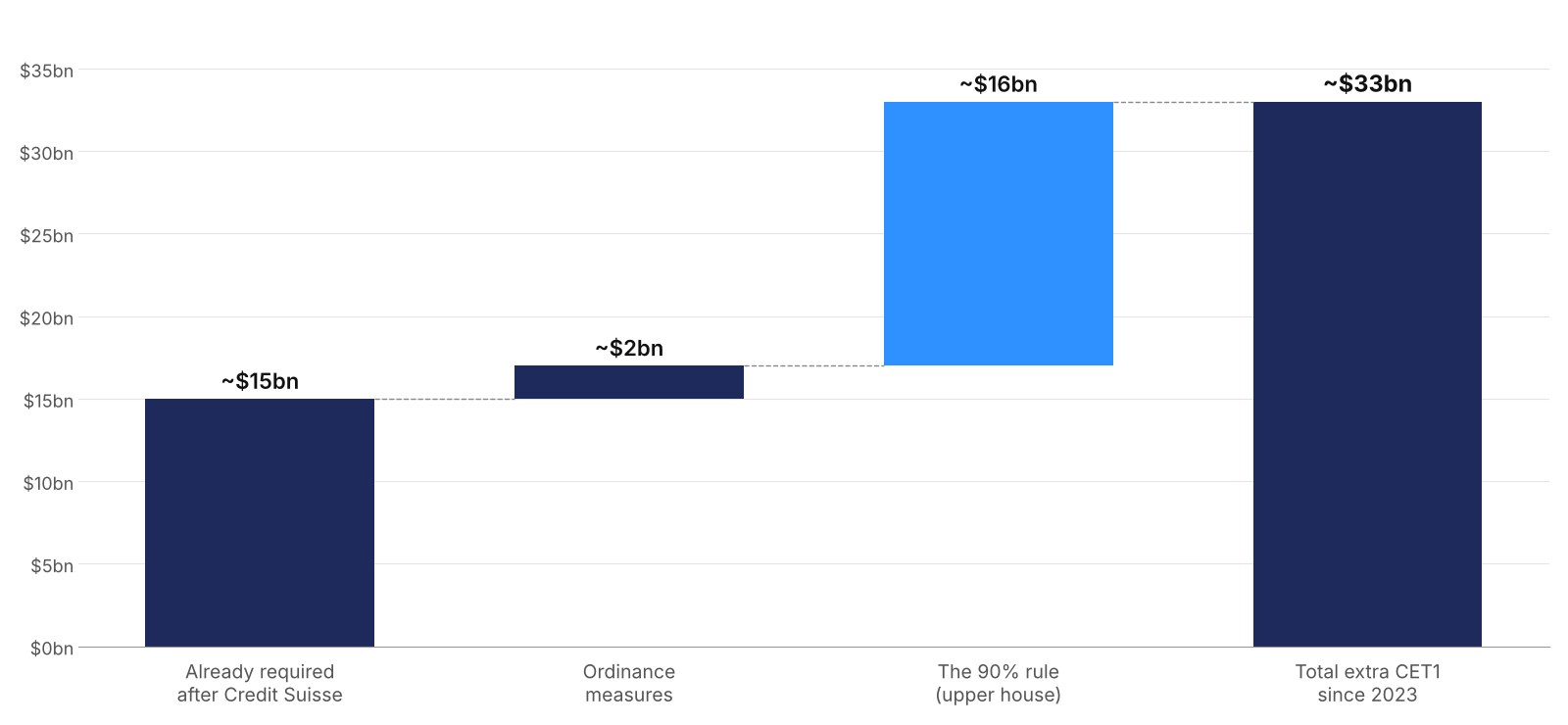
Exhibit 1: Extra CET1 capital UBS AG would have to hold since the Credit Suisse takeover if the 90% rule is confirmed, in USD bn. Source: SGMS, based on UBS statement of 23 September 2026. Data compiled by Jiaji Xie.
Call my bluff
Now for the theatre. When markets meet politics, clarity is rare. UBS chairman Colm Kelleher has warned that the bank could rethink its Swiss base if the rules get too harsh, and chief executive Sergio Ermotti said a 90% rule would be unacceptable. The bank has studied what leaving would cost, and the Financial Times reported that Rachel Reeves, then UK chancellor, pitched London to Kelleher as a new home. Two shareholders, Cevian and Artisan Partners, have openly backed a move.
On the other side, finance minister Karin Keller-Sutter is unmoved. She has pushed for tougher rules for two years and points out that UBS does not deny having the money for the capital build-up. Her camp believes being Swiss matters too much to the bank, and that leaving would cost more than staying.
Both sides have reasons to talk tough. An exit threat strengthens UBS’s hand, and brushing it off strengthens Bern’s. UBS brought in $55bn of net new assets in the third quarter alone, led by Asia-Pacific and the Americas, which shows it can grow outside Zurich. Yet on paper it can afford the rule: it is profitable and above its target, and that is exactly why parliament feels it can ask.
Meanwhile, shareholders are paying for the uncertainty. Including dividends, UBS shares were up about 8% this year by early November, against about 15% for European banks. The gap opened in September, the month of the vote.
Exhibit 2
Paying for the uncertainty
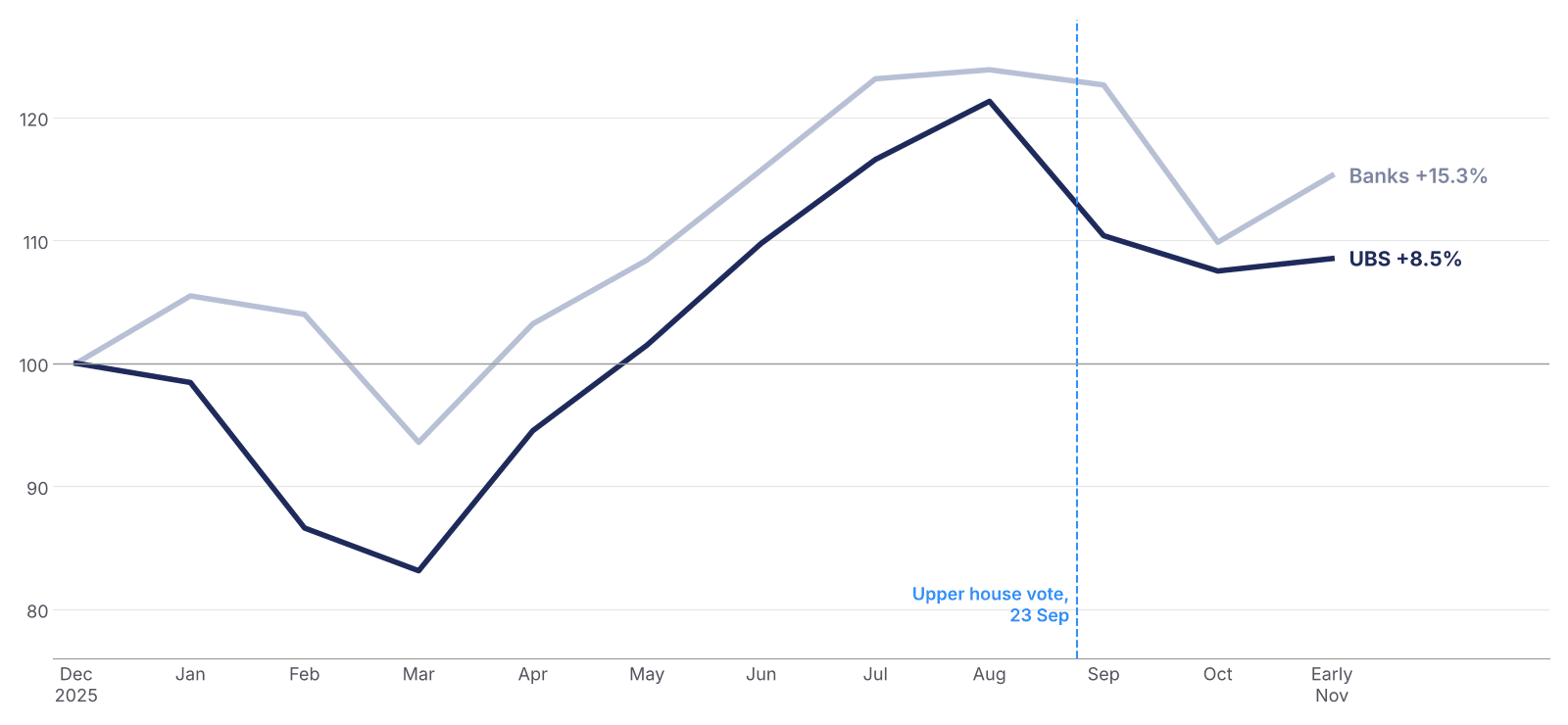
Exhibit 2: UBS shares (in CHF) against the iShares STOXX Europe 600 Banks ETF (in EUR) as a proxy for European banks, month-end, dividends included, end of 2025 = 100. Latest point early November. Not adjusted for currency. Source: SGMS, based on Digrin price data. Data compiled by Jiaji Xie.
Our view: Neither side holds the upper hand, which points to a compromise rather than an exit. UBS’s threat works better as leverage in parliament than as an actual plan. The final number will show who blinked first, because the cost of being too big to fail can only be shifted, never removed.
Capital watch
- Lower house committee, 23 and 24 November. It meets behind closed doors. One member wants UBS to value its foreign units more conservatively, which could shrink the $16bn.
- Lower house vote, December at the earliest. The next real test of the 90% figure. If the two chambers disagree, the bill goes back and forth until they agree.
- Fourth-quarter results, February 2027. The $3bn buyback should be done by then, and UBS sets its capital return plans for 2027, the first clear sign of how it intends to live with the new rule.
- A possible referendum. The Social Democrats say they will collect the 50,000 signatures needed if they see the final law as a win for UBS, which would push the outcome further out.
Switzerland cannot afford to lose UBS, while UBS weighs whether it can afford Switzerland. The 2023 crisis showed how much an unsafe bank costs. The 90% vote decides how much a safe one should cost, and who pays for it: shareholders, clients or the public. The final number will show what “too big to fail” really costs. ■
Wall Street to English
| Term | What it means |
|---|---|
| CET1 (Common Equity Tier 1) | A bank’s safest, highest-quality capital, such as shareholders’ equity and retained profits. It absorbs losses first, without a government bailout. |
| AT1 bonds (Additional Tier 1) | Risky bonds that count as capital in normal times but can be wiped out or turned into shares if the bank gets into trouble. |
| Capital requirement | The minimum amount of loss-absorbing capital a regulator makes a bank hold. |
| Too big to fail | A bank whose collapse would hurt the economy so badly that the state would feel forced to rescue it. |
| Council of States | The upper house of the Swiss parliament. The lower house is the National Council, and a bill needs both. |
| Share buyback | When a company buys back its own shares on the market, reducing the number of shares outstanding. |
Sources
- UBS, Statement on the decision by the Council of States on banking regulation, 23 Sep 2026
- UBS, Third-quarter 2026 results, 28 Oct 2026
- UBS, Third-quarter 2026 report (Form 6-K)
- Swissinfo/Bloomberg, UBS vows to keep fighting Swiss capital push after vote defeat, 23 Sep 2026
- Euronext/Reuters, UBS dealt blow as Swiss upper house backs tougher 90% capital plan, 23 Sep 2026
- Wall Street Journal, Swiss parliament’s upper house backs plan to ease new capital demands on UBS, Sep 2026
- Swissinfo/Bloomberg, UBS left reeling as Swiss finance chief wins over lawmakers, 24 Sep 2026
- Swissinfo/Bloomberg, UBS faces Swiss exit or stay and pay as capital defeat nears, 2 Oct 2026
- Swissinfo, UK government courted UBS over London HQ move (citing the Financial Times)
- Financial Times, on UBS and the Swiss capital rules
- Financial Times, on UBS and the Swiss capital rules
- Swissinfo/Bloomberg, UBS has new chance of capital compromise after lawmaker plan, 4 Nov 2026
- Reuters, UBS meets expectations with $2.7 billion third-quarter profit, 28 Oct 2026
- WealthBriefing, UBS third-quarter pre-tax profit rises 27 per cent, 28 Oct 2026
- Zacks via Yahoo Finance, UBS boosts profitability ambitions, Nov 2026
- Reuters, Credit Suisse writes down $17 billion of bonds to zero, 19 Mar 2023
- Jiaji Xie for SGMS, UBS and European banks share prices, based on Digrin (UBSG.SW and EXV1.DE), retrieved 5 Nov 2026