


“The Federal Reserve […] is in the position of the chaperone who has ordered the punch bowl removed just when the party was really warming up.”
William McChesney Martin, Fed Chair, October 1955
Barring an extraordinary surprise, the Federal Reserve will raise interest rates again on 9 December. Futures markets put the probability of a hike at 98.2% on 20 November (CME FedWatch, 20 Nov) and the minutes of its last meeting reveal that almost every official expects further increases (Federal Reserve, 18 Nov). Yet the Fed will have to make this decision with remarkably incomplete information. Last year’s government shutdown erased the October 2025 price survey, which left the latest inflation report without an annual figure (BLS, 10 Nov) and the next report will only be published the morning after the vote.
For anyone holding cash, carrying a loan or tending a portfolio, a quarter-point hike would therefore mean slightly better returns on savings, costlier borrowing and yet another restless week for bonds.
In short
- Markets see a December hike as close to certain, at 98.2% on 20 November, so the remaining debate is whether the Fed moves by a quarter point or a half point.
- Inflation has spread from petrol to services and AI-related goods, which explains why almost every Fed official expects further increases.
- The Fed decides on 9 December and its outlook for 2027 will matter more than the hike itself, while the SNB delivers its own verdict a day later.
Lights Out, Rates Up
In September, the Fed lifted its benchmark rate by 0.25 percentage points to a range of 3.75% to 4.00%, its first increase since July 2023 (Federal Reserve, 16 Sep). At its October meeting, the committee then chose patience and voted 10 to 2 to hold, while Governor Lisa Cook and Cleveland Fed President Beth Hammack argued for an immediate second hike (Federal Reserve, 28 Oct).
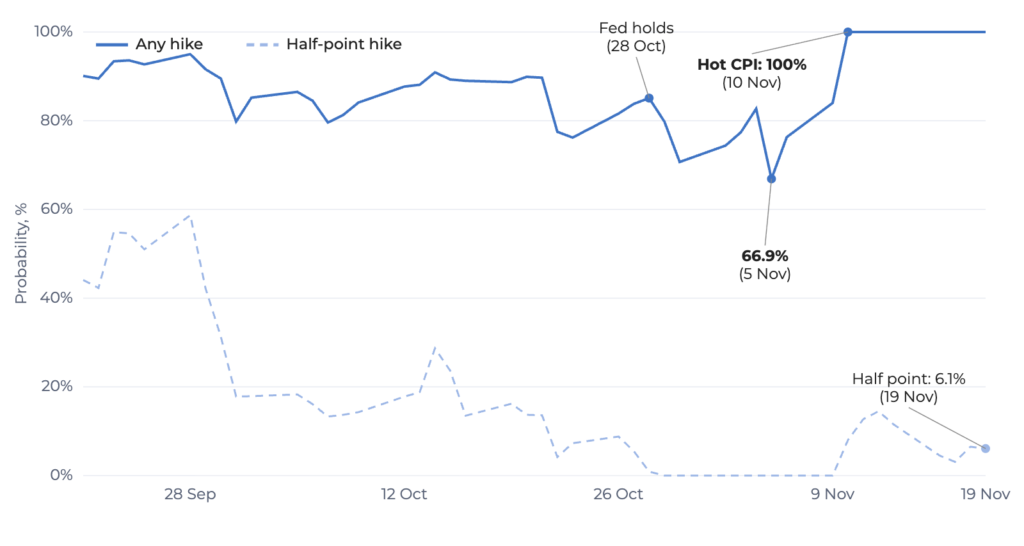
In early November, investors grew noticeably less certain and the probability of a December hike slipped to 66.9% (CME FedWatch, 5 Nov). Brent crude had just suffered its steepest weekly fall since 2020 in the week of the US midterm elections (Reuters, 6 Nov), briefly persuading the doves that cheaper energy might cool prices on its own. That hope soon faded when employers added 165,000 jobs in October against an expected 65,000 (BLS, 6 Nov). Consumer prices then rose 0.4% in a month for which economists had pencilled in 0.3% (BLS, 10 Nov). By the evening of 10 November, futures were treating a hike as a foregone conclusion (CME FedWatch, 10 Nov). The debate has since shifted towards its magnitude, with traders assigning a probability of 93.9% to a quarter-point move and 6.1% to a half-point one (CME FedWatch, 19 Nov).
Exhibit 1
Markets went from “maybe” to “definitely” in under a week: probability of a Fed hike on 9 December, 21 September to 19 November 2026
Source: SGMS, based on CME Group FedWatch Tool (30-day fed funds futures), data compiled by Arnit Dey, retrieved 20 Nov 2026. Until 28 October the line also includes the chance of an October hike.
Fuel to the Fire
Energy remains the most conspicuous culprit, as petrol at American pumps cost 37.4% more in October than a year earlier (BLS, 10 Nov). The vast majority of Fed officials still see high energy costs pushing inflation upwards (Federal Reserve, 18 Nov). Moreover, annual inflation stood at 3.7% in September, the last month for which a full comparison exists (BLS, 14 Oct), nearly twice the Fed’s 2% target.
However, policymakers are even more concerned that price increases have spread to parts of the economy far removed from the oil market. According to the minutes, most officials judged inflationary pressures to be broad based (Federal Reserve, 18 Nov). They pointed to stubborn services prices and to an artificial intelligence boom in which data centres absorb so many chips that consumers end up paying more for their gadgets. In addition, core prices, which exclude volatile food and energy, rose 0.3% for the third consecutive month (BLS, 10 Nov). Sustained over a full year, that pace would amount to roughly 3.7% (SGMS calculation), a prospect few central bankers could contemplate with much serenity.
The minutes also lay bare how finely balanced October’s pause really was. A few officials who supported it described the decision as a close call, and a couple suggested that a move larger than a quarter point might deserve consideration in December should inflation data disappoint (Federal Reserve, 18 Nov). Governor Christopher Waller went further on television that same morning, arguing for a half-point hike because inflation was spreading well beyond oil (CNBC, 18 Nov). Furthermore, a resilient labour market offers the hawks additional cover, since with unemployment down to 4.1% (BLS, 6 Nov), few officials fear that one more increase would bring hiring to a halt.
Your Wallet, Rate-Adjusted
Savers are among the few to benefit, because banks earn 3.90% on the reserves they hold at the Fed (Federal Reserve, 28 Oct). That rate rises with every hike, giving online banks room to offer depositors slightly more generous returns, although traditional banks tend to pass such gains on with glacial reluctance. Holders of credit cards and variable-rate loans, by contrast, feel the increase within days, since their interest rates are tied directly to short-term benchmarks. Borrowers who locked in a fixed rate remain largely sheltered, as federal student loans and most car loans keep the rate agreed at signing. The burden therefore falls primarily on new borrowers and on anyone hoping to refinance.
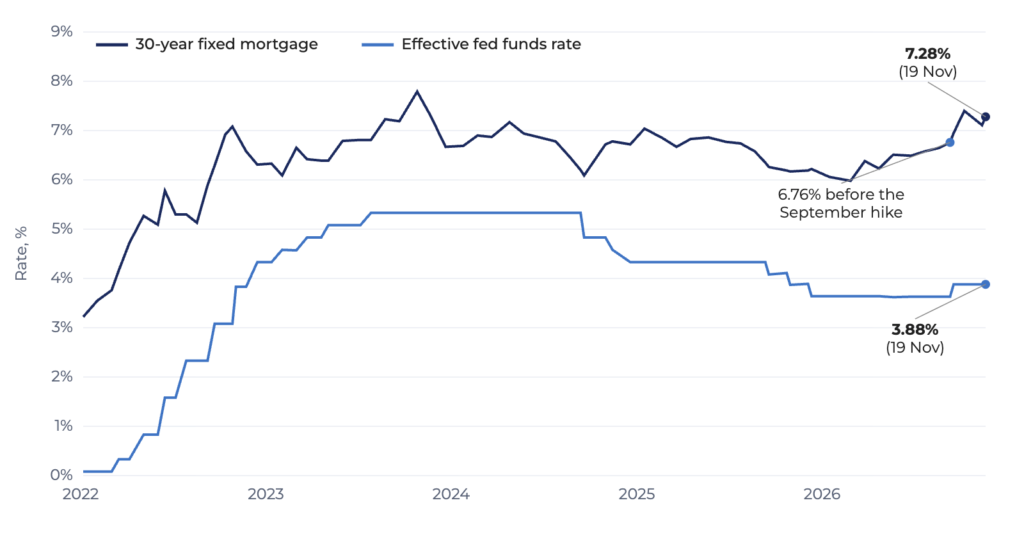
Mortgage rates track long-term bond yields more closely than the Fed, but the two have still moved in the same direction. The average 30-year US mortgage rate climbed from 6.76% in the week before the September hike to 7.28% in the week to 19 November (Freddie Mac, 19 Nov), now 3.40 points above the Fed’s rate (FRED, 19 Nov). On a USD 300,000 loan, that increase adds roughly USD 105 to the monthly repayment (SGMS calculation), enough to make many prospective homeowners reconsider the size of their dream kitchen.
Exhibit 2
Mortgages have climbed with the Fed: effective fed funds rate against the average 30-year fixed mortgage rate, January 2022 to November 2026
Source: SGMS, based on FRED (Federal Reserve Bank of St. Louis) and Freddie Mac, data compiled by Arnit Dey, 19 Nov 2026
For investors, higher rates reduce the present value of future profits, which tends to weigh most heavily on fast-growing technology companies. They also depress the price of existing bonds, whose fixed coupons suddenly look rather meagre beside newly issued debt. Since a December hike is already priced in, markets will react far more to whatever the Fed signals for 2027.
Franc-ly Speaking
Swiss readers will feel the hike only indirectly, since the Swiss National Bank still holds its policy rate at 0%, the lowest among major central banks (SNB, 24 Sep). Consequently, Swiss savings and mortgage rates follow the SNB’s lead rather than the Fed’s. A widening gap between American and Swiss rates nevertheless makes dollar deposits more attractive than franc deposits, which tends to weaken the franc against the dollar. Switzerland is also contending with an inflation surprise of its own, as consumer prices rose 1.5% in October (FSO, 3 Nov), their fastest pace in almost three years, driven largely by fuel and heating costs (investingLive, Nov 2026). SNB Chairman Martin Schlegel has since declared that the bank would not hesitate to act should price stability come under threat (Handelszeitung, 5 Nov). As a result, economists now contemplate a Swiss hike at the SNB’s meeting on 10 December, only a day after the Fed’s decision.
Our view: A quarter-point hike on 9 December looks all but settled, so the real signal will come from the Fed’s projections for 2027. With core prices rising at an annualised pace of roughly 3.7% and the labour market still firm, we expect the Fed to keep further increases firmly on the table well into next year.
What to watch
- 25 November: October PCE inflation, the Fed’s preferred measure of prices, published alongside revised third-quarter GDP figures (BEA)
- 4 December: the November jobs report, the last major data release before the meeting (BLS)
- 9 December: the Fed’s decision, accompanied by new rate projections and Chair Kevin Warsh’s press conference, where the outlook for 2027 is likely to matter more than the hike itself
- 10 December: November consumer prices, which will arrive a day too late to influence the decision (BLS), followed by the SNB’s own verdict
Seventy-one years after Martin likened the Fed to a chaperone removing the punch bowl, his successors appear ready to repeat the gesture. This time they are doing so with the lights dimmed, while the guests are still arguing about whether the party ever truly got out of hand.
Wall Street to English
| Term | What it means |
|---|---|
| Fed funds rate | The overnight rate at which US banks lend to each other, which the Fed steers to influence every other interest rate in the economy. |
| FOMC minutes | A detailed summary of the Fed’s policy meeting, published three weeks after it takes place. |
| CME FedWatch | A tool that turns the prices of fed funds futures into the probability of each possible Fed decision. |
| Core inflation | Price growth excluding food and energy, which tend to swing sharply from month to month. |
| Hawks and doves | Hawks favour higher rates to fight inflation, while doves prefer lower rates to support growth and jobs. |
| PCE | The personal consumption expenditures price index, the Fed’s preferred measure of inflation. |
Sources
- St. Louis Fed (FRASER), The punch bowl metaphor, Oct 1955: https://fraser.stlouisfed.org/blog/?p=97
- Federal Reserve, Federal Reserve issues FOMC statement, 16 Sep 2026: https://www.federalreserve.gov/newsevents/pressreleases/monetary20260916a.htm
- Federal Reserve, Federal Reserve issues FOMC statement, 28 Oct 2026: https://www.federalreserve.gov/newsevents/pressreleases/monetary20261028a.htm
- Federal Reserve, Minutes of the Federal Open Market Committee, October 27–28, 2026, 18 Nov 2026: https://www.federalreserve.gov/monetarypolicy/files/fomcminutes20261028.pdf
- CME Group, FedWatch Tool, retrieved 20 Nov 2026: https://www.cmegroup.com/markets/interest-rates/cme-fedwatch-tool.html
- Arnit Dey for SGMS, Hike-ing in the Dark exhibit data (CME FedWatch, FRED, Freddie Mac), 20 Nov 2026
- US Bureau of Labor Statistics, The Employment Situation, October 2026, 6 Nov 2026: https://www.bls.gov/news.release/empsit.nr0.htm
- US Bureau of Labor Statistics, Consumer Price Index, September 2026, 14 Oct 2026: https://www.dol.gov/newsroom/economicdata/cpi_10142026.pdf
- US Bureau of Labor Statistics, Consumer Price Index, October 2026, 10 Nov 2026: https://www.bls.gov/news.release/cpi.htm
- The Edge/Reuters, Brent on track for steepest weekly fall since 2020, 7 Nov 2026: https://theedgemalaysia.com/node/824782
- BusinessDay/Reuters, Waller hints at more aggressive Fed response over inflation, 18 Nov 2026: https://www.businessday.co.za/world/americas/2026-11-18-waller-hints-at-more-aggressive-fed-response-over-inflation/
- Freddie Mac, Primary Mortgage Market Survey, 19 Nov 2026: https://www.freddiemac.com/pmms
- FRED, 30-Year Fixed Rate Mortgage Average in the United States (MORTGAGE30US): https://fred.stlouisfed.org/series/MORTGAGE30US
- FRED, Federal Funds Effective Rate (DFF): https://fred.stlouisfed.org/series/DFF
- Swiss National Bank, Monetary policy assessment of 24 September 2026, 24 Sep 2026: https://www.snb.ch/en/publications/communication/press-releases-restricted/pre_20260924
- swissinfo.ch, Inflation soars to 1.5 per cent in October, 3 Nov 2026: https://www.swissinfo.ch/eng/various/inflation-soars-to-1-5-per-cent-in-october/92318356
- Swiss National Bank, Interview with Martin Schlegel in the Handelszeitung, 5 Nov 2026: https://www.snb.ch/de/publications/communication/interviews/int_20261105_msl
- investingLive, SNB watches for second-round Swiss inflation effects as December rate hike bets build, Nov 2026: https://investinglive.com/central-banks/snb-watches-for-second-round-swiss-inflation-effects-as-december-rate-hike-bets-build/
- US Bureau of Labor Statistics, Release calendar, December 2026: https://www.bls.gov/schedule/2026/12_sched_list.htm
- Bureau of Economic Analysis, Release schedule: https://www.bea.gov/news/schedule/full
