

“In truth, the gold standard is already a barbarous relic.”
John Maynard Keynes, A Tract on Monetary Reform, 1923
Every finance textbook has the same page on gold: when there is a war, buy gold; when inflation comes back, buy gold. 2026 has delivered both, with a US-Israeli war with Iran since February and US inflation at 3.7%. Yet gold closed at $3,876 an ounce on 30 October, its lowest in a year and roughly 30% below its record of about $5,600 in late January. Silver is down almost 60% from its own January peak. Gold bugs, look away now.
The textbook is not wrong, it just skips a step. Our argument in one line: this war hurt gold through the one channel gold hates most, interest rates.
In short
- Gold is down about 10% this year. The war hit markets through oil and inflation, which pushed the Fed to raise rates, and higher rates are bad news for a metal that pays nothing.
- The key number is the real yield: a US government bond now pays about 2.6% above inflation, the most in almost two decades.
- Leveraged traders sold, long-term buyers kept buying. That looks more like a correction than a collapse.
Peaked too soon
Gold gained 13% in January and kept rising in February. Then the war began on 28 February, and gold had its worst month in about 17 years. June was worse, down 12%, the steepest fall since October 2008.
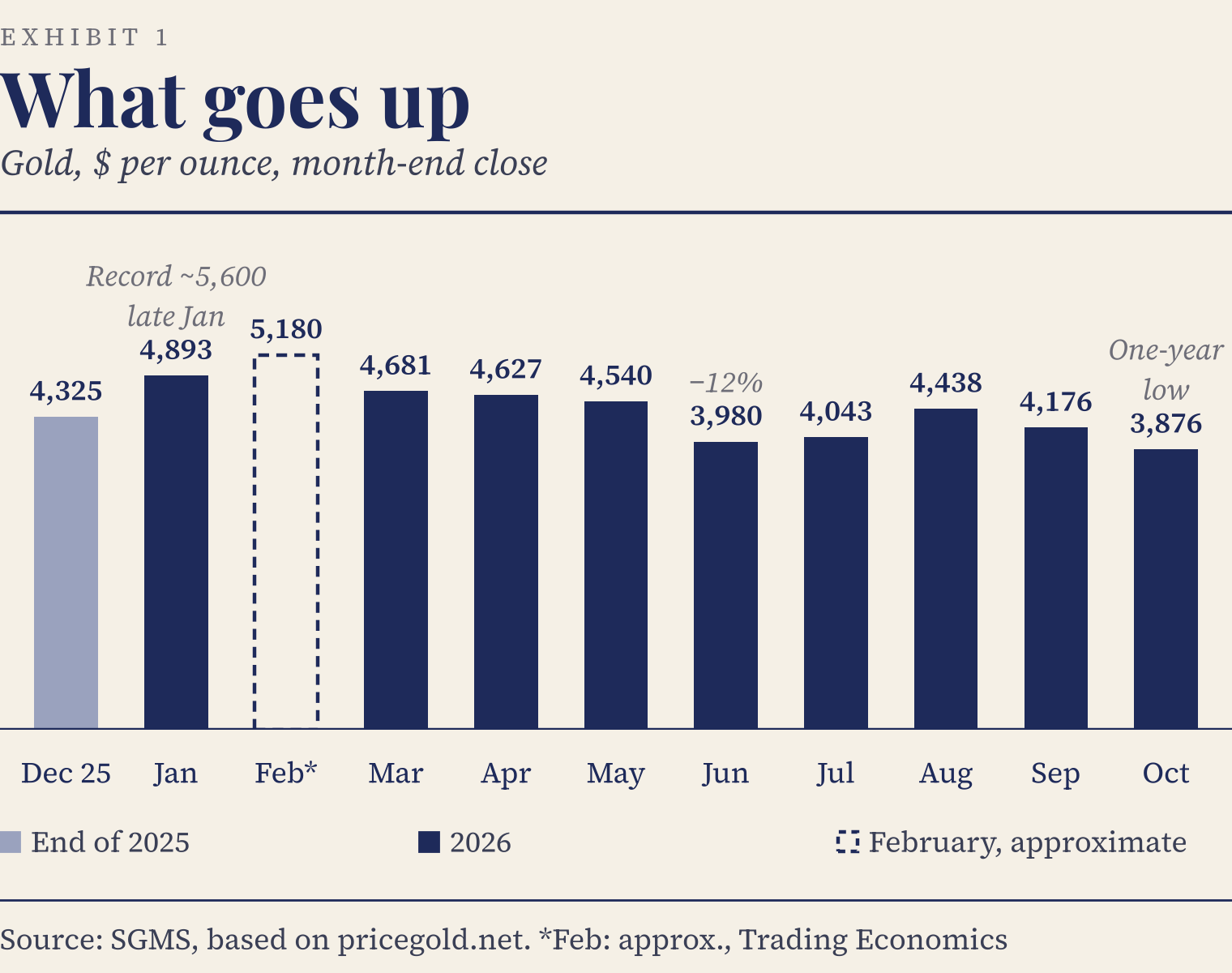
Notice the timing: gold peaked before the war, not because of it. The January rally was a bet on rate cuts. The war killed those cuts by pushing up oil and inflation, so the reason to own gold disappeared just as the reason to fear the world arrived.
Black gold beats yellow gold
What did protect investors? Mostly the thing everyone feared. Brent crude is up about 78% this year, the US dollar 3.4%. Gold and silver sit at the bottom of the table.
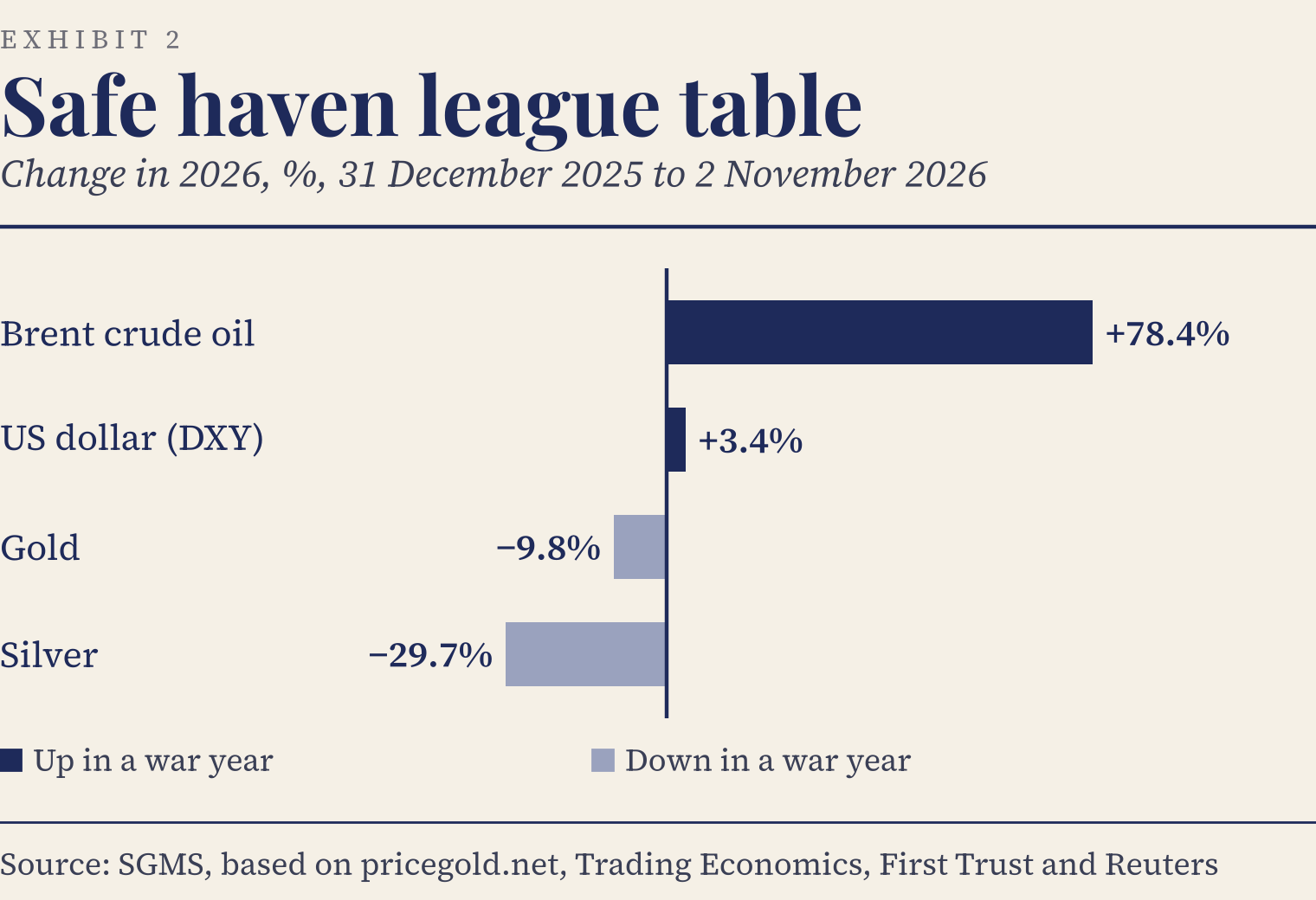
Measure it another way. On 31 December an ounce of gold bought about 71 barrels of Brent. Today it buys about 36. In oil terms, gold has lost half its value in ten months. In a supply shock, the best hedge is the scarce thing itself, not a store of value. As Philip Streible of Blue Line Futures told Kitco, markets buy whatever is causing the inflation, and right now that is oil. We looked at how much of that oil price is pure nerves in Fear by the Barrel.
The real villain: real rates
Gold pays no interest, so its true cost is what you give up by holding it. In 2026 that cost jumped. The Fed raised rates to 3.75% to 4.00% on 16 September, its first hike since July 2023, and after its October meeting markets put the chance of another on 9 December at about 85%.
The number that matters most is the real yield, what a safe US bond pays after inflation. The 10-year inflation-protected Treasury (TIPS) paid 1.9% in March and 2.65% at a September auction, the highest since 2008. In plain words: $10,000 in TIPS now earns about $260 a year above inflation, guaranteed by Washington. The same $10,000 in gold earns nothing and costs money to store. Until that gap closes, gold needs either a lower price or lower rates to win buyers back.
Fair-weather friends
The selling came from fast money. Gold is easy to sell, so when AI stocks fell hard in late October, investors facing margin calls sold gold to raise cash, as Waleed Said of GivTrade told Kitco. Borrowed money that had piled into January’s rally was unwound as rate cuts turned into rate hikes.
Slow money kept buying. Gold ETFs took in a record $31 billion in the third quarter and ended September with a record 4,256 tonnes, according to the World Gold Council. Central banks bought 289 tonnes in the second quarter, led by Poland and China.
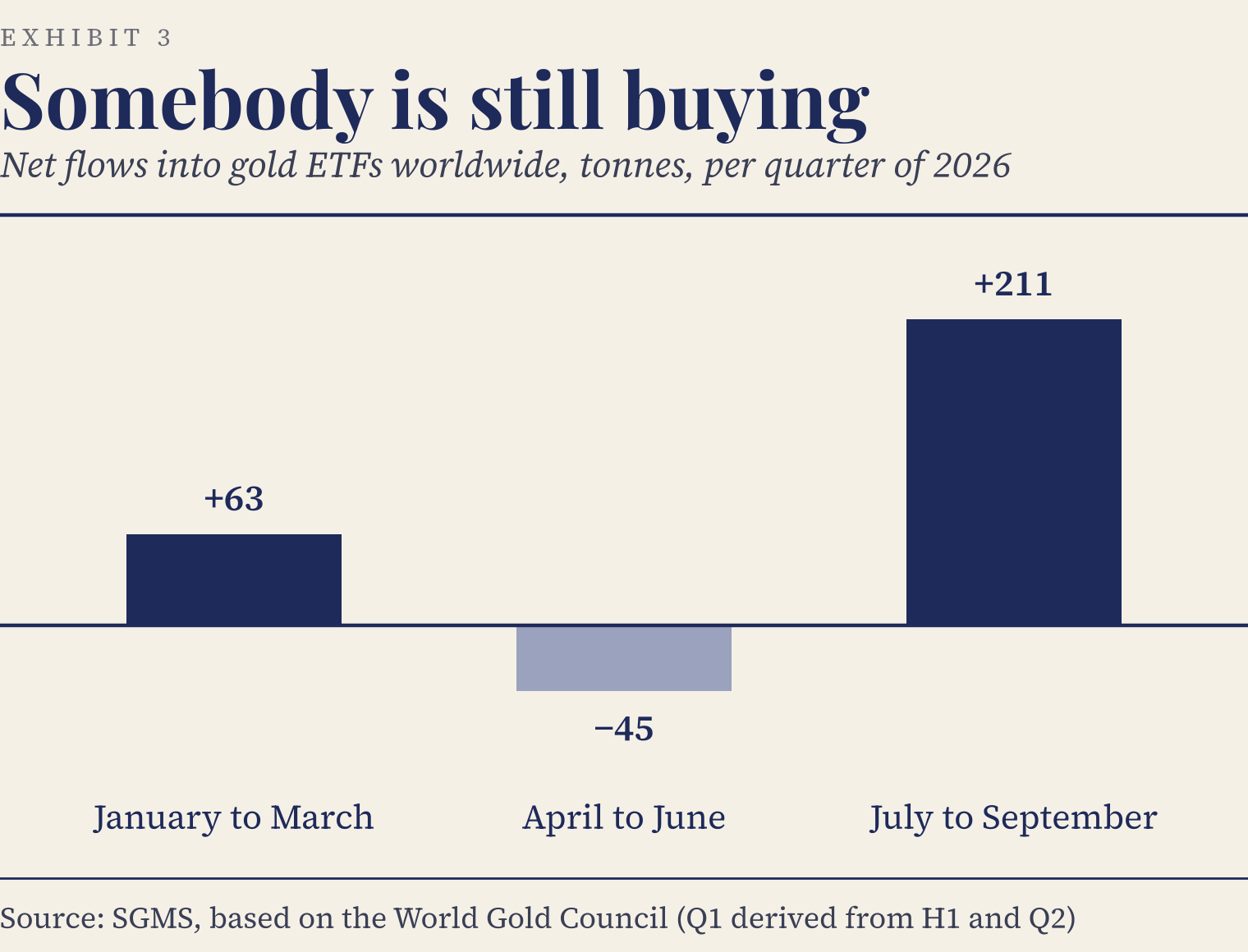
That split matters. When leveraged traders sell and long-term holders buy, a market is usually going through a correction, not a collapse: once the forced sellers are out, there is less left to sell. The caveat is October, the sharpest month, whose flow data is not out yet.
Hedge your bets
For anyone holding gold “for a crisis”, 2026 is a reminder that it matters which crisis. Gold protects against falling real rates, a weak dollar and a loss of trust in central banks. It does not protect against a shock that raises inflation and forces central banks to tighten, which is exactly what this war is. Gold’s fall is also a vote of confidence: markets believe the Fed will do what it takes. If gold rebounded sharply without any peace deal, that would be the warning sign.
Our view: as long as real yields stay around 2.5%, gold struggles. The things that would turn it are, oddly, good news: a deal with Iran that lowers oil and inflation, or a Fed that stops hiking.
Mark your calendar
- Iran, after the midterms. A deal would cut oil and inflation. Bad news for oil traders, good news for gold.
- US jobs report, Friday 6 November. Strong numbers make a December hike more likely.
- The Fed, 9 December. A hike is mostly priced in. A pause would be a gift to gold.
- October ETF flows. The first test of whether long-term buyers stayed through the worst month.
Keynes called the gold standard a barbarous relic. In 2026 gold has been a rather well-behaved one, doing exactly what real rates tell it to. Until they fall, the safe haven stays a safe haven’t. ■
Wall Street to English
| Term | What it means |
|---|---|
| Safe haven | An asset investors buy when they are scared, expecting it to hold its value. |
| Real yield | The interest a bond pays after subtracting expected inflation. |
| TIPS | US government bonds whose value rises with inflation. |
| ETF | Exchange-traded fund, a fund that trades like a share. Gold ETFs hold physical gold. |
| Margin call | A demand from a broker to add money after losses on borrowed money. |
Sources
- Kitco, Gold plunges to one-year low below $3,900, 30 Oct 2026: https://www.kitco.com/news/article/2026-10-30/gold-prices-plunge-one-year-low-below-3900-higher-oil-prices-fuel-fears
- Saxo, Market Quick Take, 2 Nov 2026: https://www.home.saxo/en-sg/content/articles/macro/market-quick-take—markets-find-calm-after-friday-turmoil—-2-november-2026-02112026
- pricegold.net, Gold price in October 2026: https://pricegold.net/2026/october/
- pricegold.net, Gold price in January 2026: https://pricegold.net/2026/january/
- Trading Economics, Gold set for monthly gain, 27 Feb 2026: https://tradingeconomics.com/commodity/gold/news/528868
- Trading Economics, Gold, Brent and US dollar index prices: https://tradingeconomics.com/commodity/gold
- Profit/Reuters, Gold heads for worst monthly fall since 2008, 30 Jun 2026: https://profit.pakistantoday.com.pk/2026/06/30/gold-heads-for-worst-monthly-fall-since-2008-as-rate-hike-bets-strengthen
- First Trust, Gold, silver and the miners, 22 Oct 2026: https://www.ftportfolios.com/Commentary/MarketCommentary/2026/10/22/gold,-silver,-and-the-miners
- investingLive, Fed hikes for the first time in three years, Sep 2026: https://investinglive.com/central-banks/fomc-rate-decision-fed-hikes-for-the-first-time-in-three-years/
- Admirals, FOMC October 2026: Fed holds rates, Oct 2026: https://admiralmarkets.com/analytics/traders-blog/fomc-october-2026-fed-holds-rates
- TIPSWatch, 10-year TIPS reopening gets real yield of 2.653%, 17 Sep 2026: https://tipswatch.com/2026/09/17/10-year-tips-reopening-gets-real-yield-of-2-653-highest-in-nearly-18-years/
- Trading Economics, US 10-year TIPS yield: https://tradingeconomics.com/united-states/10-year-tips-yield
- World Gold Council, Gold ETF holdings and flows, Oct 2026: https://www.gold.org/goldhub/research/gold-etfs-holdings-and-flows/2026/10
- World Gold Council, Gold Demand Trends Q2 2026: https://www.gold.org/download/file/21011/Q2_2026_GDT_Press_Release.pdf
