

How did you go bankrupt? Two ways. Gradually, then suddenly.
Ernest Hemingway, The Sun Also Rises, 1926
In this morning’s Market Recap we told you France briefly paid 5% to borrow for ten years, a level last seen in 2002, and that Moody’s spared it a downgrade on Friday. Here is the longer version. The eurozone’s second-largest economy is now priced by bond markets like something much smaller, and the story starts fifty years ago.
Gradually: fifty years of “we’ll see”
France has not balanced a budget since 1974, the year ABBA won Eurovision with Waterloo. Fitting, since French public finances have been meeting their Waterloo every year since. Debt was about 64% of GDP in 2007, just under 100% on the eve of Covid and 119% today, roughly €3.5 trillion.
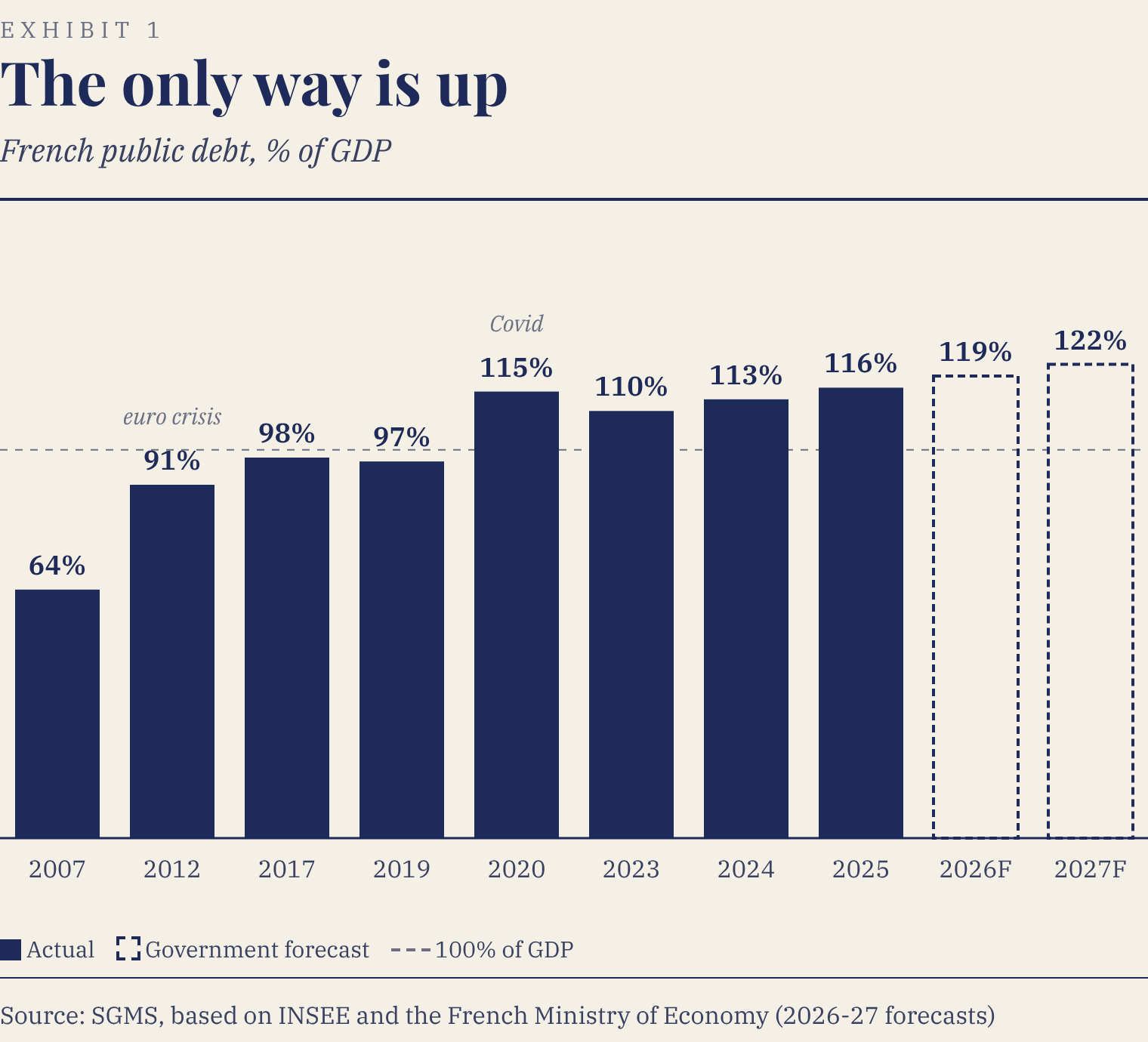
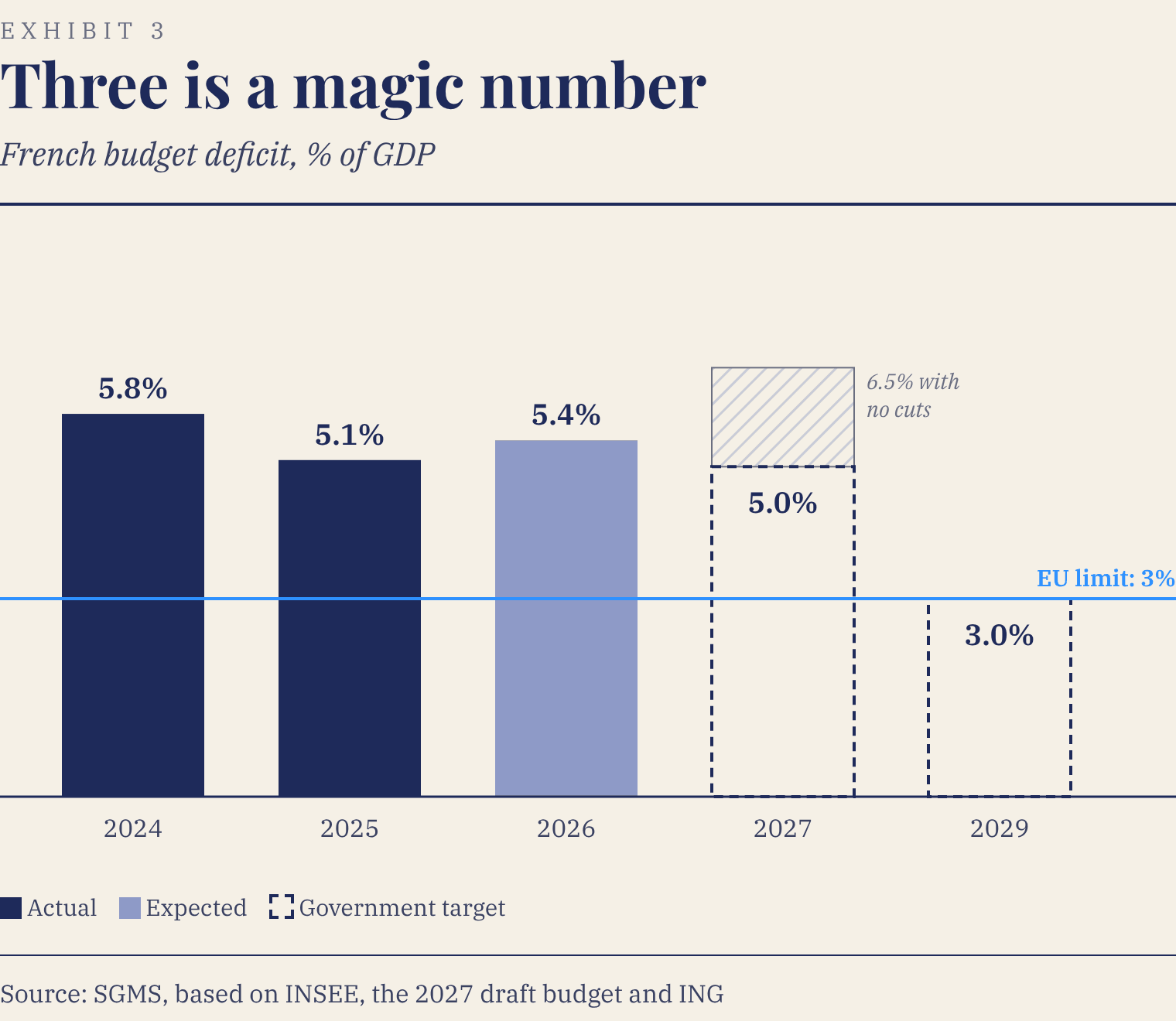
France is the only G7 country whose debt is still above its pandemic level. The deficit, the gap between what the state spends and earns in a year, is expected at 5.4% of GDP in 2026, against an EU limit of 3%. Brussels has France in its excessive deficit procedure, which is EU for “we are watching you”.
Suddenly: France spreads itself thin
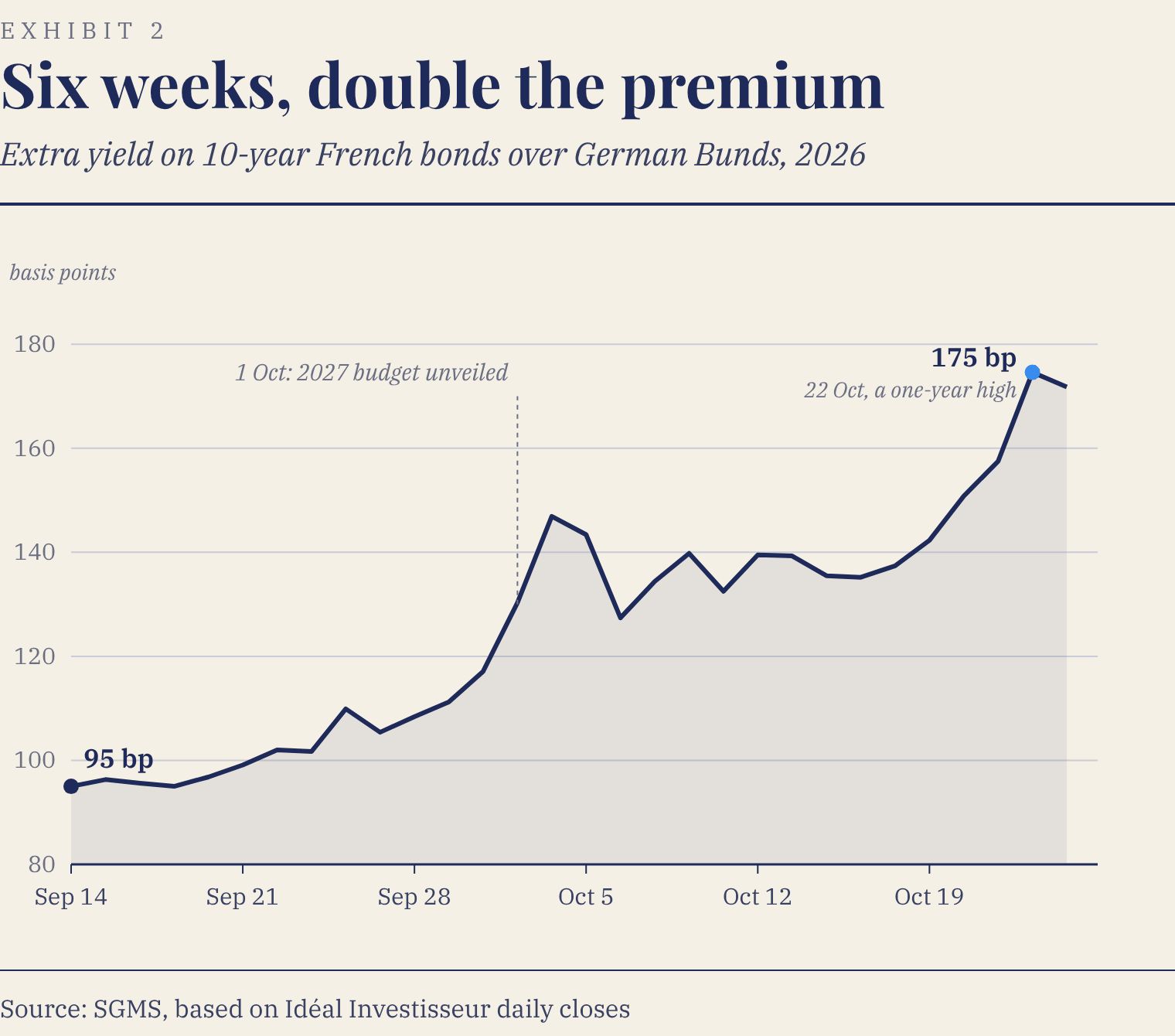
The cleanest gauge of investor nerves is the spread: the extra yield investors demand to lend to France rather than Germany for ten years. It was about 95 basis points in mid-September. On 22 October it hit 175, the widest since the 2011-12 euro crisis.
Then came the Italian job. On 9 October France paid a record 30 basis points more than Italy to borrow for ten years, the biggest gap since the euro was born, and French yields also climbed above Greece’s. In 2012 Italy paid over 4 percentage points more than France. For the French this stings more than the 2006 World Cup final, and that one at least went to penalties.
The rating agencies are circling too. Fitch and S&P already cut France to A+ last autumn. Moody’s held Aa3 on Friday, but with a negative outlook, the yellow card before the red. S&P is back on 27 November.
Liberté, égalité, austérité
On 1 October Prime Minister Sébastien Lecornu presented a 2027 budget that finds about €54 billion, mostly through smaller pension increases, a public-sector pay freeze and cheaper sick leave, while defence gets €6.4 billion more. The goal is a deficit of 5% of GDP next year and 3% by 2029. Without it, the government says the deficit would drift towards 6.5%.
France’s own fiscal watchdog called the 1% growth forecast behind the plan “optimistic”, and ING says that even fully implemented it would only slow the deterioration. Passing it is another story. The government has no majority, the 2026 budget was only forced through in February with article 49.3 (which adopts a law without a vote unless parliament topples the government), and Moody’s thinks the 2027 one may end up adopted by decree. Meanwhile protests over fuel prices and the cost of living turned into riots on 17 and 18 October, with more than 2,000 arrests. Austerity is a hard sell in that mood.
Interest-ing times
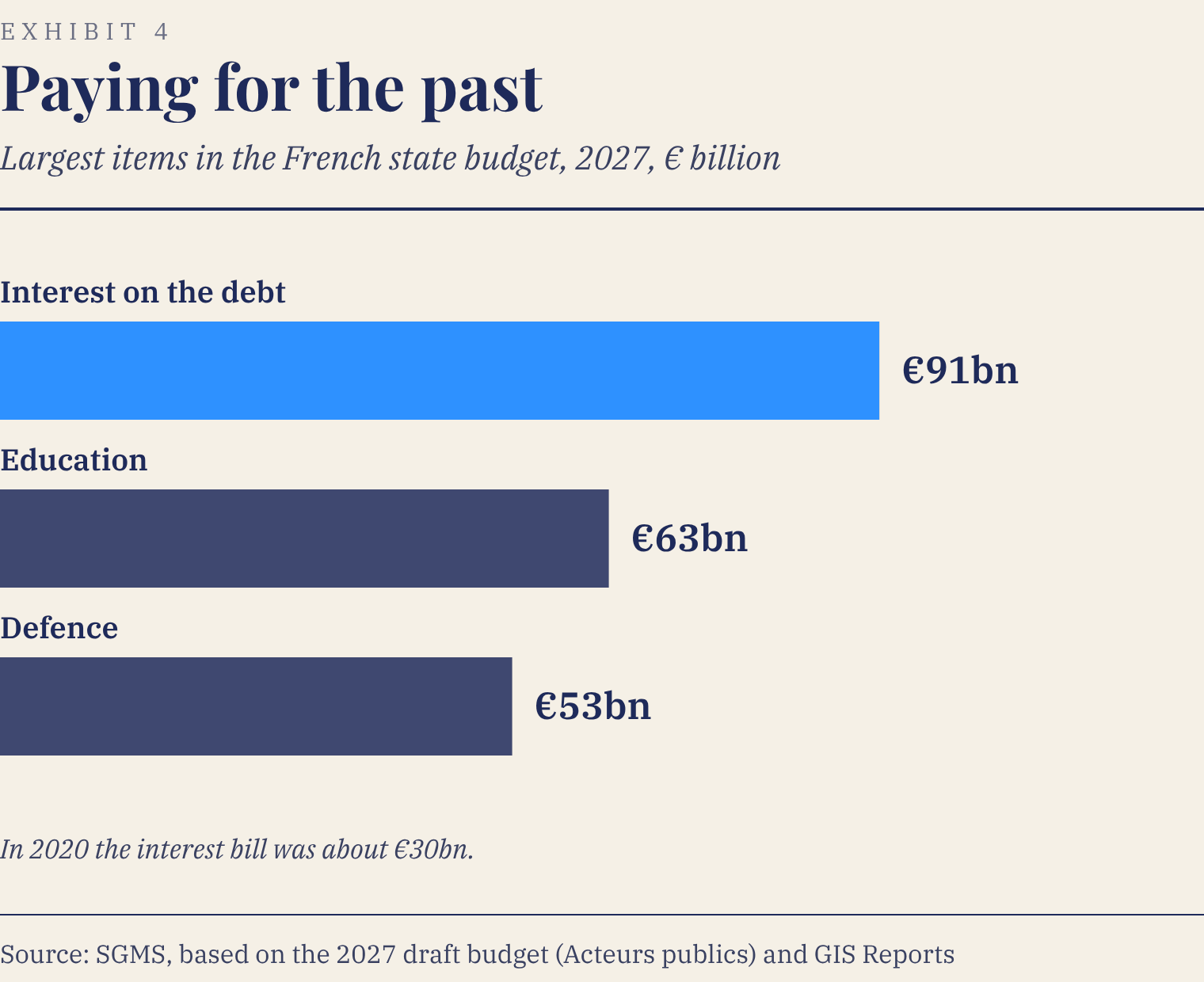
France never really repays its debt. It rolls it over, swapping maturing bonds for new ones at today’s rates. With an average maturity of about 8.5 years, higher rates seep in slowly, but they seep in every year. Interest cost about €30 billion in 2020. In 2027 it reaches about €91 billion, now the state’s biggest single expense, ahead of education and defence.
All the signals are flashing red.
Carine Camby, French Court of Audit, June 2026
Economists call it the snowball effect: when the interest rate on debt beats the growth rate of the economy, debt grows by itself. With growth at 0.4% and new ten-year money costing 5%, France’s snowball is rolling downhill.
Hold the croissance
Croissance is French for growth, and France is running out of it.
- Growth. INSEE expects 0.4% this year, behind most of France’s neighbours.
- Jobs. Unemployment is heading for 8.6%. It has not been below 7% since the 1970s.
- Industry. About 25% of the economy in the 1970s, just above 10% today.
- Living standards. Over 25 years, real GDP per person grew at only 59% of the OECD average pace.
Put simply, France taxes a lot, spends even more and grows little. You can cut spending by decree. You cannot decree growth.
Greece is the word? Not yet.
This is not Athens in 2010. French banks are healthy, the debt is long-dated, the rating is solidly investment grade and the economy is about twelve times the size of Greece’s. As Capital Economics puts it, “France’s challenge is fiscal rather than financial”.
Two things still keep traders up at night. Foreigners now hold about 57.5% of French government debt, and they sell faster than domestic savers. And the ECB’s emergency tool, the TPI, only helps countries that respect EU fiscal rules, which France currently does not. The safety net exists. It is just harder to reach.
Coming soon to a bond market near you
- ECB, 29 October. Rates are expected on hold. Any hint of support for bond markets will move French yields first.
- The budget. A 49.3, a decree or a fallen government. Each tells markets how much of the €54 billion survives.
- S&P, 27 November. A cut to A would leave France two notches below its Moody’s rating.
- April 2027. The presidential election, with far-right and far-left candidates leading the polls. Markets doubt either would cut the deficit.
France is not about to default. It is something slower and more French: a rich country paying more and more for decisions it keeps putting off. Gradually has lasted fifty years. Markets are now asking whether suddenly arrives next spring. C’est la dette. ■
Wall Street to English
| Term | What it means |
|---|---|
| OAT / Bund | French and German government bonds. The Bund is the eurozone’s safe benchmark. |
| Spread | The extra yield one borrower pays over another, here France over Germany. |
| Basis point | One hundredth of a percentage point. 100 basis points = 1%. |
| Deficit vs debt | The deficit is one year’s overspending. The debt is the pile of all past deficits. |
| Rating outlook | A negative outlook means a downgrade is more likely than an upgrade in the next 12 to 18 months. |
| Snowball effect | When interest costs grow faster than the economy, debt rises on its own. |
| Article 49.3 | A French constitutional tool that passes a law without a vote, unless parliament brings down the government. |
| Excessive deficit procedure | The EU process for countries running deficits above 3% of GDP. |
| TPI | Transmission Protection Instrument, the ECB’s tool to buy a country’s bonds if yields rise for reasons it judges unjustified. |
Sources
- Fortune, France’s latest debt warning, 24 Oct 2026
- Investing.com, French yields retreat from 2002 highs as Moody’s holds, 26 Oct 2026
- Idéal Investisseur, OAT/Bund spread history, Oct 2026
- Briefs, French 10-year premium over Italy hits record, 9 Oct 2026
- Tech Times, France bond yields top Italy and Greece, 5 Oct 2026
- ING Think, France’s budget offers no quick relief for bond markets, Oct 2026
- EU Insider, France’s budget bets on 1% growth, Oct 2026
- Acteurs publics, Debt interest set to reach €91bn in 2027 (in French), Oct 2026
- Banque des Territoires, Court of Audit warns all signals are red (in French), Jun 2026
- The Star/AFP, INSEE cuts France’s 2026 growth forecast to 0.4%, 11 Sep 2026
- GIS Reports, France’s fragile economic future, 14 Sep 2026
- Apollo, French debt dynamics, 8 Oct 2026
- Scripps News, France grapples with worst rioting in years, 19 Oct 2026
