

When a measure becomes a target, it ceases to be a good measure.
Marilyn Strathern, summing up Goodhart’s law, 1997
Berkshire Hathaway has invested billions in wind power, but not because of ESG. Asked about it in 2014, Warren Buffett said the tax credit was the only reason to build wind farms. For the world’s best-known investor, what matters is a company’s long-term earning power, and environmental, social and governance factors count only when they show up in it.
That is the right test for ESG. The idea is good. But the evidence suggests it changes investors’ decisions far less than promised, partly because the way it is measured rewards words over proof. Our view: ESG’s real power lies elsewhere, with the general public. Clear, honest numbers aimed at customers, employees and voters can put pressure on companies that investors alone have not.
In short
- ESG means taking environmental, social and governance issues into account when investing. Most ESG ratings measure risk to a company’s profits, not the good it does, and not the harm it hides.
- The system fails in two ways: companies can look sustainable by improving their reports, while real improvers in “dirty” industries are excluded anyway.
- ESG also involves real trade-offs: fewer investments to choose from, and conflicts between what is good for the climate, for people and for growth.
- ESG has changed investors’ decisions less than promised. It should be aimed at the general public instead: a few audited numbers, progress against a sector pathway and a check on what companies say versus what they do, communicated so that anyone can understand them.
What ESG is, and who pushed it
The European Commission defines sustainable finance as taking environmental, social and governance considerations into account in investment decisions. E covers climate and pollution. S covers human rights, labour and community engagement. G is how a company is run: how its board is organised, how diverse it is and how management is overseen.
Behind it sits an old debate. Milton Friedman argued in 1970 that a company has no social responsibility beyond making profits for its owners. Stakeholder theory, associated with R. Edward Freeman, answers that companies create costs for others, such as pollution, and should take responsibility for them, which is the idea behind corporate social responsibility (CSR).
ESG took off between 2006 and 2008, after the UN-backed Principles for Responsible Investment (PRI) were launched at the New York Stock Exchange. Much of the push came from the largest asset managers, such as BlackRock and Amundi. Critics point out that they also had a commercial interest, because an asset manager earns a percentage of the money it manages:
New ESG funds attracted new money, and with it new fees. That does not make ESG wrong, but it explains why the label spread faster than the substance.
The good: where ESG pays
A simple valuation formula shows where ESG can matter:
Value depends on next year’s cash flow (CF1), the cost of capital (r) and growth (g). ESG creates value only if it changes one of the three.
- Cash flow, through reputation and margins. Swiss running-shoe brand On built its image on sustainability. In 2024 an investigation by Swiss public broadcaster SRF questioned its sustainability claims and conditions at supplier factories in Vietnam, which On disputed. For a brand, a reputation hit like this goes straight to pricing power and sales.
- Cost of capital, through risk. The strongest evidence: companies with poor ESG records are more exposed to crises and disasters, fossil-fuel firms tend to pay a higher cost of equity, and green-energy firms tend to borrow more cheaply. A study of S&P 500 firms by Gutsche and co-authors at HSG also finds that ESG disclosure moves firm value more than actual ESG performance does: investors seem to mistake long reports for good behaviour.
- Growth. There is little evidence that “doing good” speeds it up. And causality can run backwards: companies with higher earnings often have higher ESG scores simply because they can afford sustainability teams and projects.
The bad: rewarding words, punishing improvers
The first question is what a rating should even tell you. As an investor, what you most want from an ESG report is to know what bad things the company is doing. Instead, MSCI, the largest provider, says its ratings measure a company’s resilience to financially relevant ESG risks: the effect of the world on the company, not of the company on the world. Many investors still read them as a “goodness” score, as finance professor Aswath Damodaran has pointed out.
Then come the measurement problems:
- Ticking boxes. Many indicators ask whether a company has a policy, on human rights or emissions, for example. Anyone can write a policy. Few indicators check whether it is applied, and impact itself cannot be audited the way financial statements can.
- Size bias. Ratings often use emissions divided by revenue. That makes large companies look cleaner even when they pollute far more, as the example below shows. Large firms also publish more data and employ teams to answer rating questionnaires (Drempetic, Klein and Zwergel, 2020).
- Who sets the weights? Providers combine hundreds of indicators, and someone has to decide which matter most. Investors themselves disagree: older investors may care more about data privacy, younger ones about the environment. There is no neutral weighting.
The large firm emits 50 times more CO2, yet looks twice as “green” per euro of revenue.
The result is that raters disagree. Berg, Kölbel (now at HSG) and Rigobon compared six providers and found that their ratings of the same firms correlate at only 0.54 on average. Credit ratings from Moody’s and S&P correlate at 0.99. Most of the gap is about facts, not taste: 56% comes from measuring the same issue with different indicators, 38% from covering different issues, and only 6% from weighting them differently.
Exhibit 1
ESG raters agree far less than credit raters
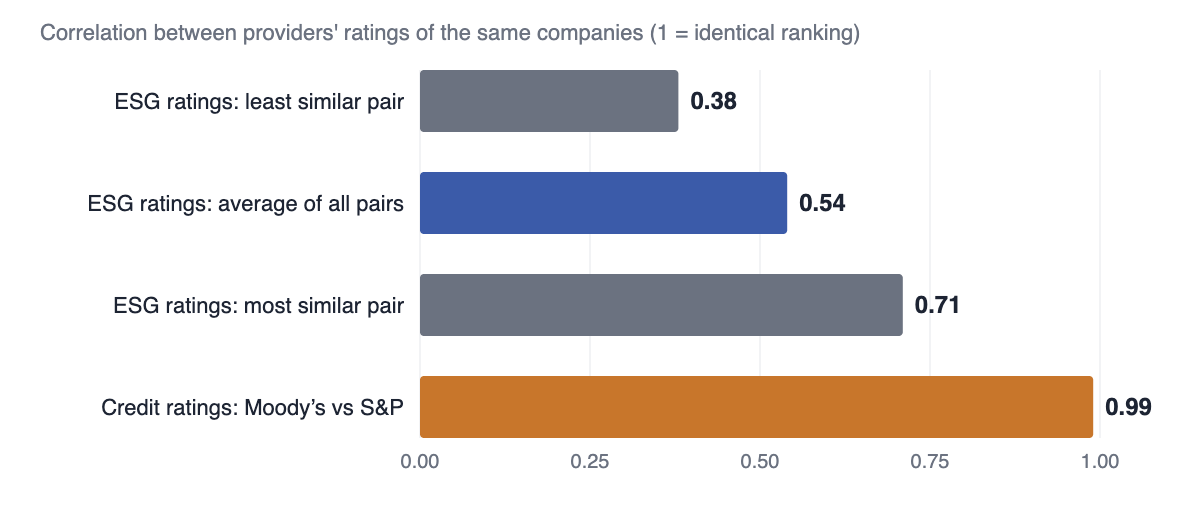
Source: SGMS, based on Berg, Kölbel and Rigobon (2022). ESG figures are pairwise correlations across six raters.
The same holds for the names investors know best. For 1,049 companies in the MSCI World index, Billio and co-authors (2021) found these rank correlations between the big providers:
| MSCI | Refinitiv | S&P Global | |
|---|---|---|---|
| Refinitiv | 0.43 | ||
| S&P Global | 0.45 | 0.69 | |
| Sustainalytics | 0.53 | 0.64 | 0.69 |
Even MSCI and Refinitiv, two of the most widely used providers, rank the same companies with a correlation of just 0.43, far from the 0.99 of credit ratings.
This produces two opposite failures:
- Words rewarded. ESG reports can become marketing. A cigarette maker can earn a strong governance score for an excellent board report while almost all its revenue still comes from cigarettes. The report improves; the business does not. That is greenwashing.
- Improvers punished. CRH, the building-materials group, sits in cement, one of the most carbon-intensive industries, and sector-wide carbon screens tend to catch every producer, whatever its plans. While listed in London it traded at a discount of about 26% to its peers, according to the Irish Times. Activist investor Cevian, which held about 4%, said in 2022 that CRH was valued at a record discount to its peers. CRH moved its primary listing to New York on 25 September 2023, and its shares rallied after the switch.
The trade-offs nobody likes to mention
- ESG has a portfolio cost. Every exclusion shrinks the set of investments you can hold, so you lose some diversification and may miss the best risk-return combinations. ESG is not value investing: it can mean paying more for “good” companies, or skipping cheap ones.
- E and S can conflict. Flowers grown in Ethiopia and flown to Europe are bad for the climate, but they provide jobs for Ethiopian workers. Which letter wins?
- Sustainability and growth can conflict. A phone that lasts ten years is greener, but companies and investors want upgrades and growth. Innovation is needed, not just restraint.
Does it matter for investors?
Investors say it does. In a global survey of senior investment professionals by Amel-Zadeh and Serafeim, 82% of the 419 who answered said they use ESG information in their decisions. The main reason was money, not morals: 63% of users said ESG information matters for investment performance, while only 33% called it an ethical responsibility. Among the 18% who do not use it, the second most common reason was a lack of reliable, comparable data (21%). That is exactly the measurement problem above.
Eurosif, the European sustainable investment forum, groups ESG strategies into seven types:
| Strategy | What it does | Watch out for |
|---|---|---|
| Exclusion | Removes sectors or firms, e.g. tobacco or coal | Blunt: punishes improvers |
| Norms-based screening | Flags breaches of international standards (UN Global Compact, OECD, ILO) | Says little about positive impact |
| Positive selection | Keeps the best-rated firms in each sector: more proactive | Depends on which rater you use |
| Thematic | Invests in themes such as clean energy or water | Doing the right thing does not guarantee doing it right |
| ESG integration | Includes ESG risks in normal financial analysis | Only as good as the data |
| Engagement | Uses votes and dialogue with boards | Slow and hard to measure |
| Impact investing | Targets measurable social or environmental results | Often private, illiquid, higher risk |
The money is moving towards the approaches closest to the financials. In the Global Sustainable Investment Alliance’s (GSIA) 2020 review, ESG integration was the largest strategy, at about $25 trillion, and grew 44% in two years, while exclusion and positive selection shrank by about a quarter. By the 2022 review, which counted assets more strictly, engagement had become the most common strategy, followed by integration and exclusion.
Exhibit 2
Money moved from screens to integration
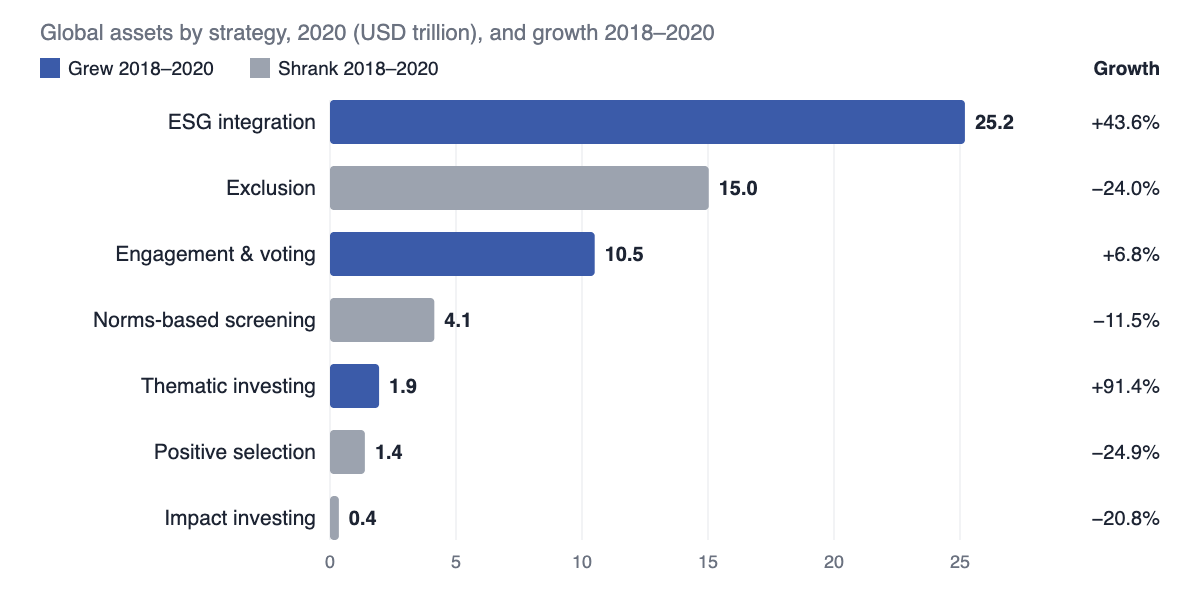
Source: SGMS, based on GSIA Global Sustainable Investment Review (2020). The 2022 review changed its methodology, so figures are not directly comparable.
Still, saying you use ESG information is not the same as acting on it. Nor can investors simply ignore it: even managers that position themselves against ESG, such as Strive, still vote on boards and pay. Governance never goes away.
Proof over prose: how to fix it
ESG does not need to be abandoned. It needs to judge companies on direction and proof rather than levels and words. Four changes would do it.
1. Measure a few material numbers, audited. The SASB materiality map, now part of the ISSB’s global standards, shows which issues matter financially in each industry. Each company should report three to five of them in physical units, such as tonnes of CO2 per tonne of cement or the share of revenue from cigarettes, rather than whether it has a policy. A strong governance score should never offset the core business.
2. Score progress against a sector pathway. A cement maker will always emit more than a bank. The fair question is whether it is improving fast enough for its industry. Example: a producer cuts emissions from 0.60 to 0.52 tonnes of CO2 per tonne of cement in three years, while its sector pathway requires 2.5% a year:
It beats the pathway, so it should count as a transition leader, not be excluded.
3. Translate every action into money. If that producer makes 20 million tonnes a year, pays a carbon price of about €85, close to where EU carbon allowances traded in November 2026, and invests €400 million to get there:
If being seen correctly also lowers its cost of capital from 8% to 7.5%, a company with €1 billion of cash flow growing at 2% gains about €1.5 billion in value:
The sustainable choice and the financial choice become the same choice. (Figures are illustrative.)
4. Check the gap between saying and doing. Each year, compare how much a company’s report talks about sustainability with how its audited numbers actually moved.
| Numbers improved | Numbers flat or worse | |
|---|---|---|
| More ESG language | Genuine progress | Greenwashing flag |
| Same ESG language | Quiet improver: reward it | Neutral |
Two habits make this stick: link part of executive pay to two or three of the audited numbers rather than to a rating, and keep shares and engage rather than sell, since an owner who sells has no voice. Regulation is moving the same way: since 2 July 2026, the EU’s ESG Ratings Regulation requires rating providers to be authorised and supervised by ESMA and to disclose their methods. Existing providers had until 2 November to apply.
So, does ESG matter? Yes, but to the public
For investors, less than its supporters hoped. Most say they use ESG information, but it has done little so far to redirect capital or change how companies behave. Investors look at long-term earning power, as Buffett does, and a noisy score that experts cannot agree on rarely changes that.
That is why ESG should be aimed at the general public instead. Pressure that reaches customers, employees and voters works directly on what investors care about: sales, reputation and the ability to hire. When Swiss public television questioned On’s sustainability claims, the pressure came from the media and the public, not from an ESG rating. So the numbers in this article (audited emissions, progress against a sector pathway, the gap between what a company says and does) should be published in a form anyone can read, not hidden in a 200-page report.
Turn the chain around: instead of ratings moving investors and investors moving companies, informed people move companies, and investors follow the cash flows. Then ESG stops being a label and becomes what it was meant to be, good for the company and for the world.
What to watch
- ESMA’s register of authorised ESG rating providers, and whether rating methods become more consistent.
- Adoption of the ISSB standards, which would give companies a common set of material numbers to report.
Wall Street to English
| Term | What it means |
|---|---|
| ESG rating | A score a provider gives a company on ESG issues; most measure risk to the company, not its impact. |
| AUM | Assets under management: the money an asset manager invests for clients. |
| Correlation | How closely two sets of numbers move together, from −1 to 1; 1 means identical rankings. |
| Materiality | Whether an issue is important enough to affect a company’s financial results. |
| Greenwashing | Presenting a company or fund as more sustainable than it really is. |
| Sector pathway | The rate at which an industry must cut emissions to meet climate targets. |
| Cost of capital | The return investors require to hold a company’s shares or debt. |
Sources
- World Economic Forum, “Should we subsidise wind farms?”, December 2014 (quoting Warren Buffett, 2014)
- European Commission, Overview of sustainable finance
- Friedman, M., “The Social Responsibility of Business Is to Increase Its Profits”, New York Times Magazine, 13 September 1970
- Damodaran, A., “The ESG Movement: The ‘Goodness’ Gravy Train Rolls On!”, Musings on Markets, 14 September 2021
- MSCI, ESG Ratings
- NYU Stern Center for Business and Human Rights, “Why Roger Federer Finds His Brand in the Crossfire”, 2024
- Gutsche, R., Schulz, J.-F. and Gratwohl, M., “Firm-value effects of CSR disclosure and CSR performance”, EFMA Annual Meeting, 2017
- Amel-Zadeh, A. and Serafeim, G., “Why and How Investors Use ESG Information: Evidence from a Global Survey”, Financial Analysts Journal, 2018
- Billio, M. et al., “Inside the ESG ratings: (Dis)agreement and performance”, Corporate Social Responsibility and Environmental Management, 2021
- Berg, F., Kölbel, J. F. and Rigobon, R., “Aggregate Confusion: The Divergence of ESG Ratings”, Review of Finance, 2022
- Drempetic, S., Klein, C. and Zwergel, B., “The Influence of Firm Size on the ESG Score”, Journal of Business Ethics, 2020
- Eurosif, Responsible investment strategies
- Global Sustainable Investment Alliance, Global Sustainable Investment Review 2020
- Global Sustainable Investment Alliance, Global Sustainable Investment Review 2022
- SASB / IFRS Foundation, Materiality Map
- Regulation (EU) 2024/3005 on the transparency and integrity of ESG rating activities
- ESMA, ESG Rating Providers
- S&P Global, EU carbon allowance prices, 9 November 2026
- The Irish Times, “Who’s next? Big Apple takes bite out of Irish market with CRH and Flutter moves”, 3 March 2023
