

There is no such thing as liquidity of investment for the community as a whole.
John Maynard Keynes, The General Theory, 1936
On Monday, BlackRock asked the SEC, the US markets regulator, to approve a new kind of fund: the exchange-traded interval fund, or ETIF. The idea is to pack private credit and other private assets, normally reserved for pension funds and the very wealthy, into a share you can trade on the stock exchange like any ETF. HPS, the private credit firm BlackRock bought last year, is on the application too.
The timing is bold. As we wrote in Semi-Liquid, Fully Stuck, 2026 was the year private credit investors queued for the exit, and BlackRock’s own $26 billion HPS Corporate Lending Fund capped withdrawals in March. Our argument in one line: the ETIF is a better exit than a queue and the SEC should allow it, but after fees most of the extra yield goes to the manager, so we would only buy one below its value.
In short
- An ETIF would trade on an exchange like an ETF, but the fund itself would buy back shares only once a month, and only from big trading firms, not from you.
- That lets it hold far more private loans than the 15% an ETF is allowed, with an all-day exit through the market instead of a queue.
- Our view: the SEC should say yes, but investors should not pay full price. On our estimates fees eat most of the private credit premium, and in a sell-off the shares will trade below their value.
Meet the parents
The ETIF crosses two existing funds. An ETF trades on an exchange, and its price stays close to the value of what it owns, its net asset value (NAV), thanks to large trading firms called authorised participants (APs). They can hand shares back to the fund every day for the underlying securities. If the ETF trades below NAV, an AP buys the cheap shares, swaps them for the more valuable securities and pockets the gap, which pushes the price back up. That only works if the securities are easy to sell, which is why US rules cap hard-to-sell (illiquid) assets at 15% of an ETF.
An interval fund does not trade on an exchange. It buys back a slice of its shares at set intervals, typically 5% a quarter, at NAV. Needing cash only a few times a year, it can hold loans that take months to sell. The downside became clear this year: when everyone wants out at once, you wait in line.
Some assembly required
The ETIF takes the listing and the APs from the ETF, and the periodic buyback from the interval fund. According to the filing:
- You trade on the exchange. Anyone can buy or sell the shares through a normal broker, during the day.
- The fund buys back monthly. It offers to repurchase at least 2% of its shares each month, and no more than 25% over any three months.
- Only APs can sell to the fund. They hand back large blocks of shares for cash, securities or a mix. Ordinary investors cannot take part.
- Leaving the fund directly costs extra. A repurchase fee of up to 2% is allowed.
Say the fund’s loans are worth $100 per share, but the shares trade at $97. An AP buys at $97, hands them to the fund at the next monthly window and receives $100 of assets. Its buying narrows the gap. That is the theory, anyway.
Exhibit 1
Family resemblance
| ETF | Interval fund | ETIF (proposed) | |
|---|---|---|---|
| Where you buy and sell | Stock exchange, all day | From the fund only | Stock exchange, all day |
| When the fund buys back shares | Every day, from APs | Usually quarterly, about 5% | Monthly, at least 2%, capped |
| Who can sell to the fund | APs | Every shareholder | APs only |
| Hard-to-sell assets | Max 15% | No fixed cap | No fixed cap |
| Price you get when you leave | Market price, close to NAV | NAV, if the queue allows | Market price, possibly below NAV |
Exhibit 1: How the ETIF compares with its two parents. Source: SGMS, based on the ETIF application filed with the SEC and Morrison Foerster.
Private assets, public appetite
Why now? The SEC under Paul Atkins wants ordinary savers to have more access to private markets, and on 30 September it proposed the biggest overhaul of interval fund rules since 1993. BlackRock also runs iShares, the largest ETF family in a US market worth about $16 trillion, and with HPS it now owns a private credit factory. The ETIF connects the factory to the busiest shop window in finance. Rivals have tried shortcuts: State Street and Apollo’s PRIV ETF typically keeps 10% to 35% in private credit, with Apollo promising to bid for the loans so they can count as liquid. BlackRock is asking for new rules instead of stretching the old ones.
Thinking inside the box
BlackRock has not named a first fund, strategy or fee. With HPS on the application, private credit is the obvious candidate, so we built our own guess.
Start with what private loans earn. Loans that funds make directly to mid-sized companies have returned about 9.5% a year since 2004, according to the Cliffwater Direct Lending Index. At the end of 2025 they yielded about 9.9%, against about 7.0% for syndicated loans that trade in the market. Those 3 points are the reward for locking your money up, and they do not always show up: in 2025, high-yield bonds that you can sell any day did just as well.
Exhibit 2
Paid to wait?
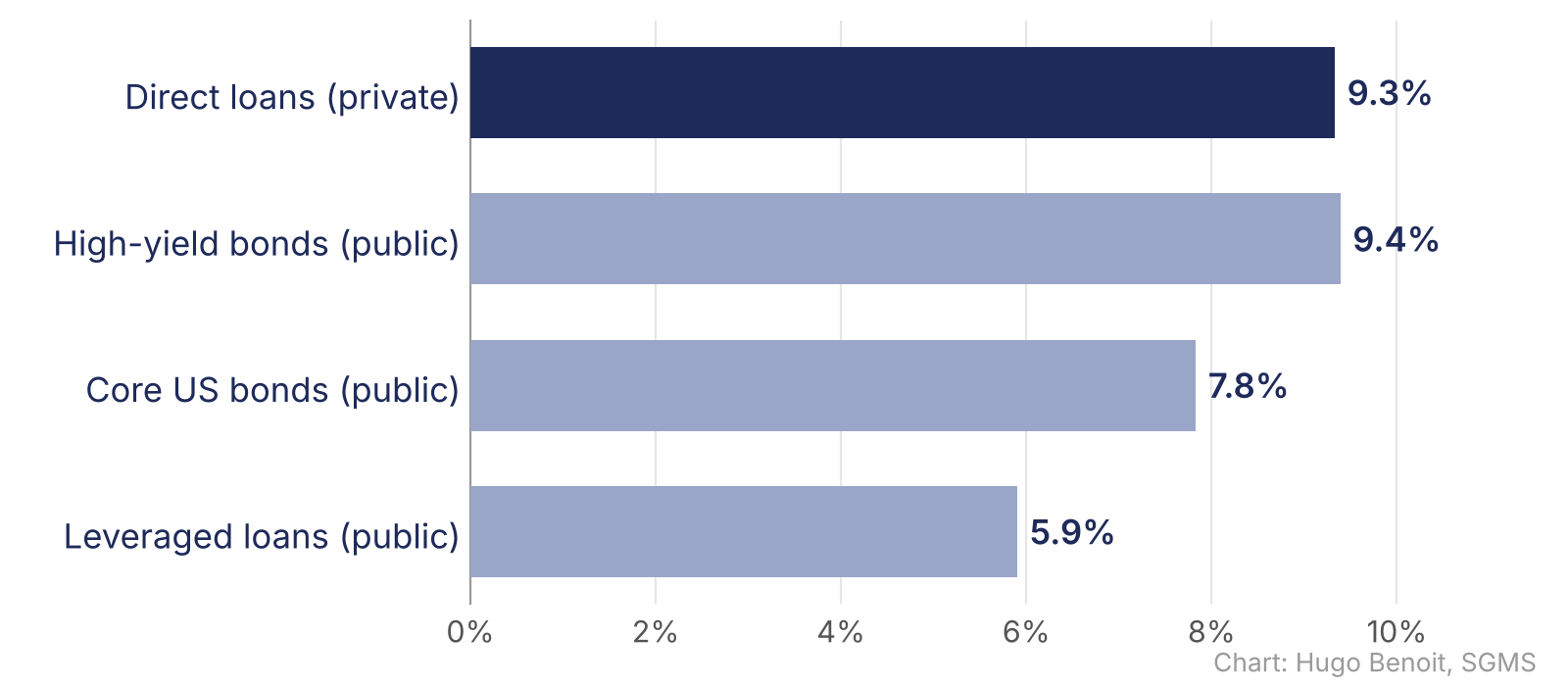
Exhibit 2: Total return in 2025, %. Direct loans: Cliffwater Direct Lending Index, before fees. Leveraged loans: Morningstar LSTA index, derived from the 3.4-point gap Cliffwater reports. Source: SGMS, based on Cliffwater via Larry Swedroe. Chart by Hugo Benoit.
Now the portfolio. BlackRock’s HPS interval fund, CREDX, targets 30% to 50% in private investments. An ETIF must pay APs every month and survive busy days on the exchange, so we assume a bit more cash: 45% private loans, 45% public credit and 10% cash. That is three times what an ETF may hold in hard-to-sell assets.
Exhibit 3
What’s in the box?
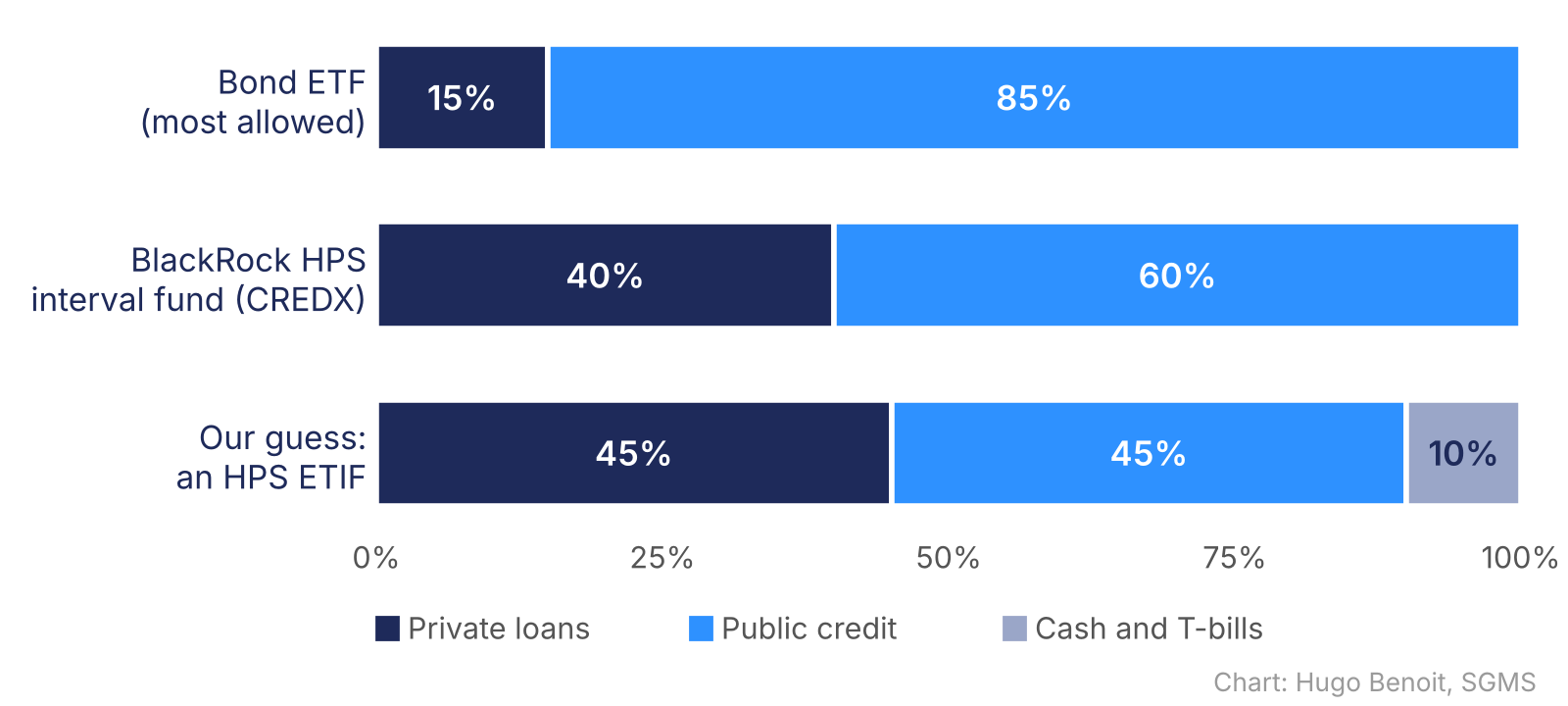
Exhibit 3: Share of the portfolio. Bond ETF: the most US rules allow in hard-to-sell assets. CREDX: midpoint of its 30% to 50% private target. ETIF: our guess, not BlackRock’s plan. Source: SGMS, based on SEC Rule 22e-4 and BlackRock. Chart by Hugo Benoit.
Add up the yields and our ETIF earns about 8% a year before costs. Then come the fees. CREDX costs about 2.1% a year in total expenses. An exchange-traded version should be cheaper, but private loans are expensive to manage. At 1% a year you keep about 7%, at 2% about 6%. A plain leveraged loan ETF pays around 6.4% after its fee, and you can sell it any day close to its value.
Exhibit 4
Where the premium goes
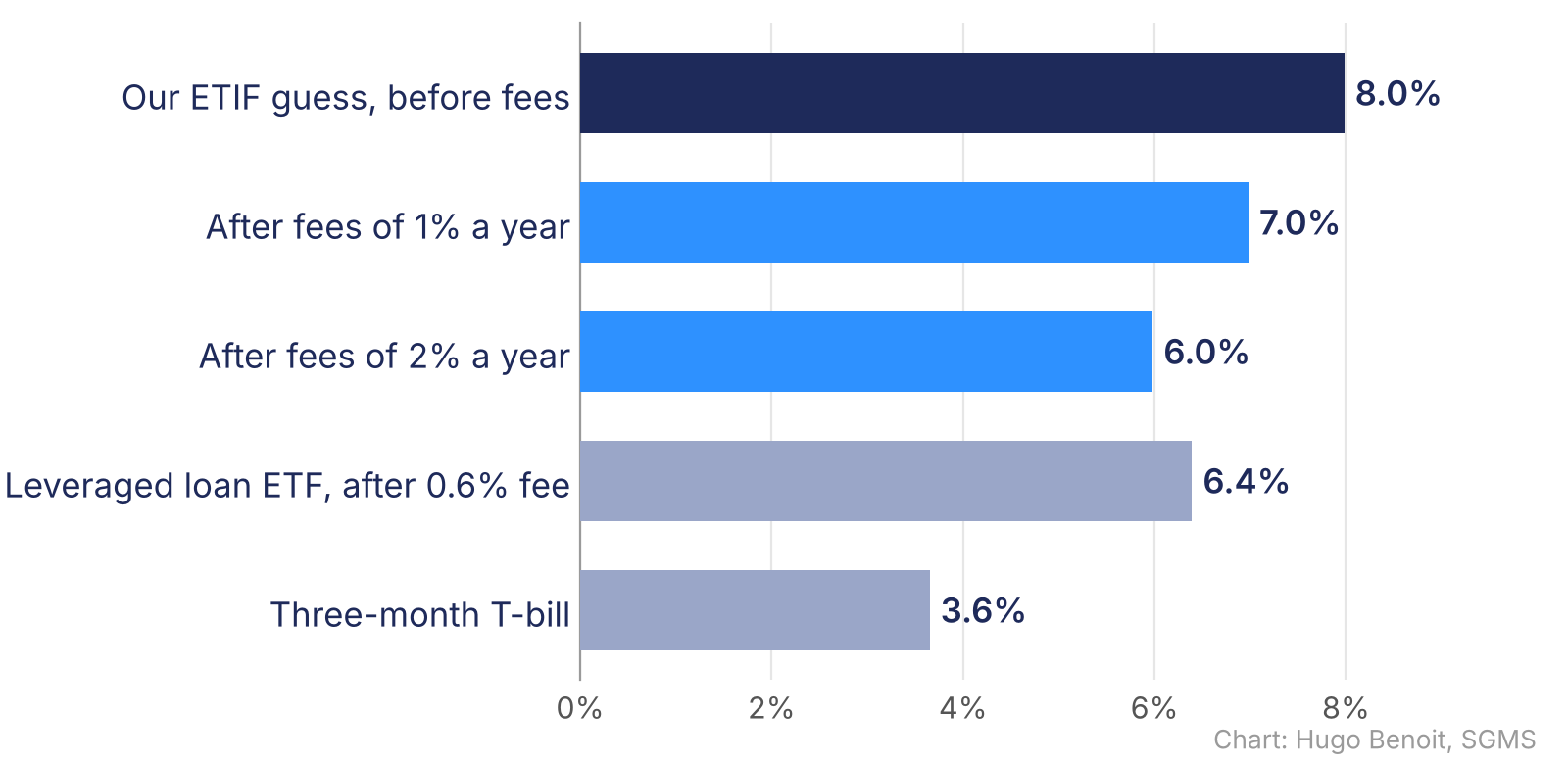
Exhibit 4: Illustrative yield, % a year, using end-2025 yields: direct loans 9.9%, syndicated loans 7.0%, three-month T-bill 3.6%. Our ETIF: 45% direct loans, 45% public credit, 10% cash. An SGMS estimate, not a forecast. Source: SGMS, based on Cliffwater, Morningstar LSTA and US Treasury auction data. Chart by Hugo Benoit.
So after fees, the 3-point premium shrinks to somewhere between minus half a point and plus half a point. These are rough estimates, but the direction is clear: most of the reward for illiquidity goes to the manager.
The price of leaving
Now the catch, which Keynes saw 90 years ago. When you sell an ETIF share, the money comes from another investor, not the fund. The loans inside are no easier to sell.
On a bad day, the buyer of last resort is the AP. It can only hand shares back once a month, and the fund only promises to take back 2% of its shares each time. Holding shares for weeks costs money and private loans are hard to hedge, so the AP bids lower. BlackRock admits it in the filing: discounts could be larger than for typical ETFs, and if they stay as wide as at listed closed-end funds, it could recommend dropping the exchange features.
How wide? Listed private credit funds, called BDCs, have no buyback at all, so they show the worst case: 17% to 21% below NAV in past sell-offs, 50% in March 2020 and 16% in February this year. Even iShares’ big corporate bond ETF, LQD, closed 5% below NAV on one day in March 2020. An ETIF should land somewhere in between. In an interval fund, stress shows up as a queue. In an ETIF, it shows up as a discount, and small investors cannot avoid it by selling back to the fund at NAV: only APs can.
Exhibit 5
Fire sale prices
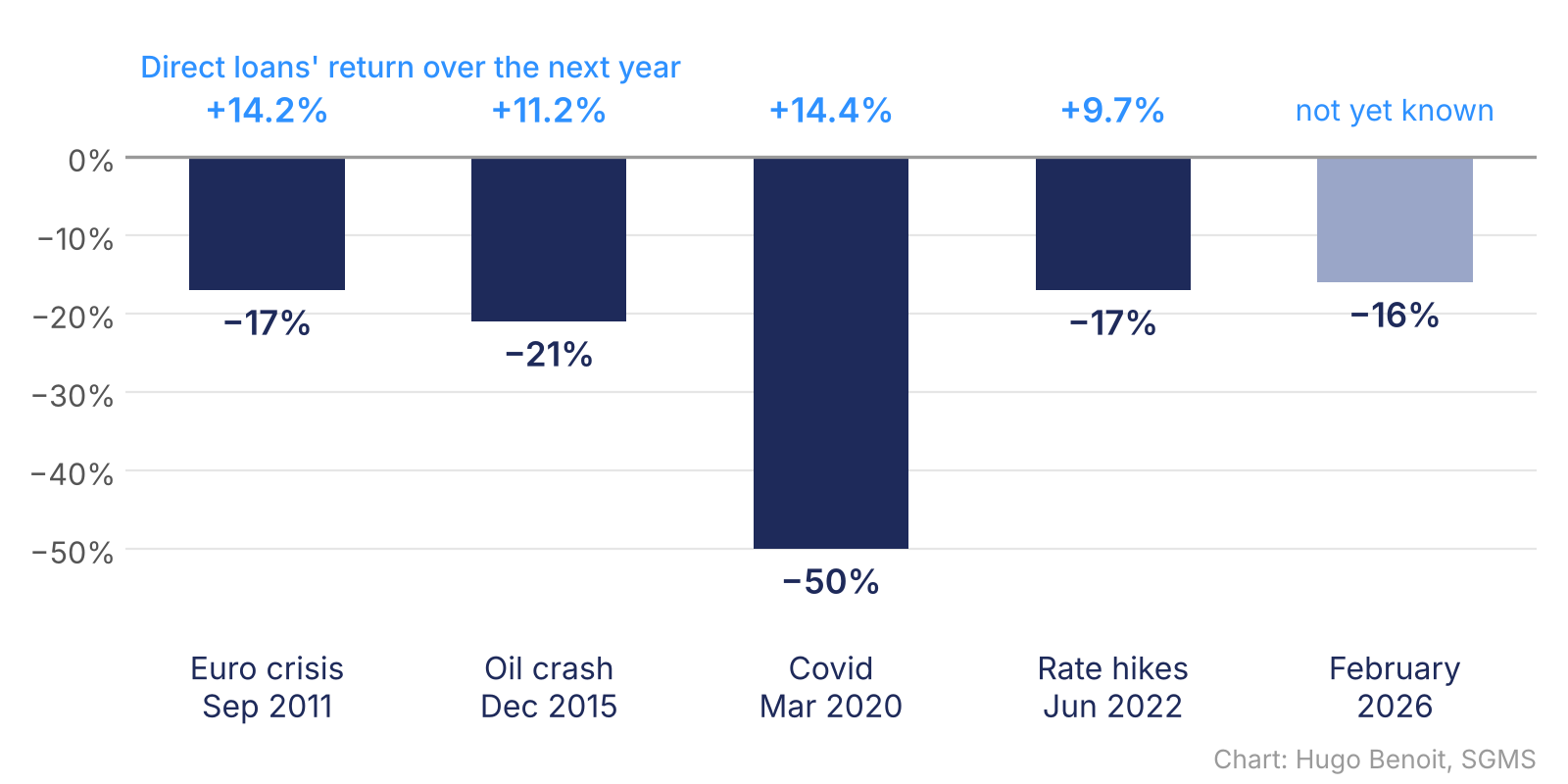
Exhibit 5: Average discount to NAV of listed private credit funds (BDCs) in five sell-offs, and the return of the Cliffwater Direct Lending Index over the following year. Source: SGMS, based on Cliffwater via Larry Swedroe. Chart by Hugo Benoit.
Wait for the sale
For the SEC: say yes, with a 5% floor. A market price next to the manager’s own valuation, all day, is more honest than a hidden queue and fairer to those who stay in. But interval funds normally have to offer at least 5% per buyback, and the SEC’s September proposal keeps that minimum for monthly offers. BlackRock asks for 2%. After this year, a narrower exit door is the last thing private credit needs.
For investors: wait for the sale. At NAV, we would not buy: on our numbers you take private credit risk for roughly public credit pay. Below NAV, the maths changes. After each past sell-off in Exhibit 5, direct loans returned 9.7% to 14.4% over the next year, so the steep discounts were buying chances, not warnings. The best ETIF trade will belong to the patient buyer on the day someone else needs out. Our rule of thumb: happy at 90 cents, never at 100.
The clearest winner is BlackRock: the fees of a private fund with the reach of an ETF. Clever business, just not a free lunch.
Next interval
- The SEC’s answer. No timeline, and approvals like this often take months.
- The 5% question. Comments on the September proposal close in December. Watch whether BlackRock keeps its 2%.
- The first fund. Its fee will tell you most of what you need to know.
- The first bad month. How far the price drifts from NAV will show whether the design works.
Keynes was right: for everyone together, an illiquid asset never becomes liquid. The ETIF does not change that. It changes who waits. In an interval fund, you wait. In an ETIF, the AP waits, and charges you a discount for the trouble. Call it interval training: the fund only does its reps once a month, but you can leave the gym whenever you like. Just check the price at the door. ■
Wall Street to English
| Term | What it means |
|---|---|
| ETF | Exchange-traded fund. A fund whose shares trade on a stock exchange all day. |
| Interval fund | A fund that does not trade on an exchange but buys back a set share of its units at regular intervals. |
| ETIF | Exchange-traded interval fund. BlackRock’s proposed mix of the two. |
| NAV | Net asset value: what the fund’s holdings are worth per share. |
| Authorised participant (AP) | A large trading firm allowed to create and hand back fund shares directly with the fund. |
| Premium / discount | How far the market price sits above or below the NAV. |
| Direct lending | Loans that funds make directly to companies, without a bank and without a market to trade them. |
| Syndicated loans | Large company loans arranged by banks and traded between investors. |
| BDC | Business development company. A US fund that lends to mid-sized companies; some are listed on the stock exchange. |
| Exemptive relief | Permission from the SEC to do something the standard rules do not allow. |
Sources
- BlackRock, HPS and others, ETIF exemptive application filed with the SEC, 16 Nov 2026
- Bloomberg, BlackRock Seeks to Break ETF Mold With Private-Market Hybrid, 16 Nov 2026
- TokenPost, Eric Balchunas on BlackRock’s monthly-redemption fund structure, 16 Nov 2026
- BlackRock, BlackRock Completes Acquisition of HPS Investment Partners, 1 Jul 2025
- Advisor Perspectives (Bloomberg), BlackRock Sees Private Credit Tumult as Way to Take Market Share, 14 Apr 2026
- Morrison Foerster, SEC Proposes Changes to Interval Fund Exemptive Rules, Oct 2026
- Dechert, SEC Proposes to Modernize the Interval Fund Framework, Oct 2026
- Faegre Drinker, SEC Open Meeting Advances “Responsible Retailization” Agenda, 2 Oct 2026
- State Street, PRIV fund page, 2026
- Larry Swedroe, The Sky Isn’t Falling (Cliffwater CDLI and BDC discount data), Feb 2026
- Angel Investors Network, Cliffwater CDLI fact page data as of 31 Dec 2025, 2026
- BlackRock, HPS Credit Strategies Fund (CREDX) allocation targets, 2026
- MutualFunds.com, CREDX expense ratio, Jul 2026
- US Treasury three-month bill auction results, Dec 2025 (via FXBlue)
- WealthManagement.com, LQD closes at a 5% discount to NAV, Mar 2020
- BlackRock, Introduction to interval funds
