



History doesn’t repeat itself, but it often rhymes.
Attributed to Mark Twain
In our Week 45 Market Recap we told you Washington turned blue and the AI trade turned red. Here is the longer version: what the 2026 midterms mean for stocks. Democrats won both the House and the Senate on 3 November, while the White House stays Republican. Investors cheered on Wednesday, with the Dow up more than 1,500 points. On Thursday the S&P 500 fell 4.4%, and it ended the week 2.7% lower, its worst week since April 2025.
So was the vote bad news for markets? History says no: in the twelve months after every midterm since 1950, the S&P 500 ended higher. Our argument in one line: the sell-off was not a response to divided government, but to a specific risk for the AI sector: slower growth in data centre construction.
Exhibit 1
How the Senate turned blue
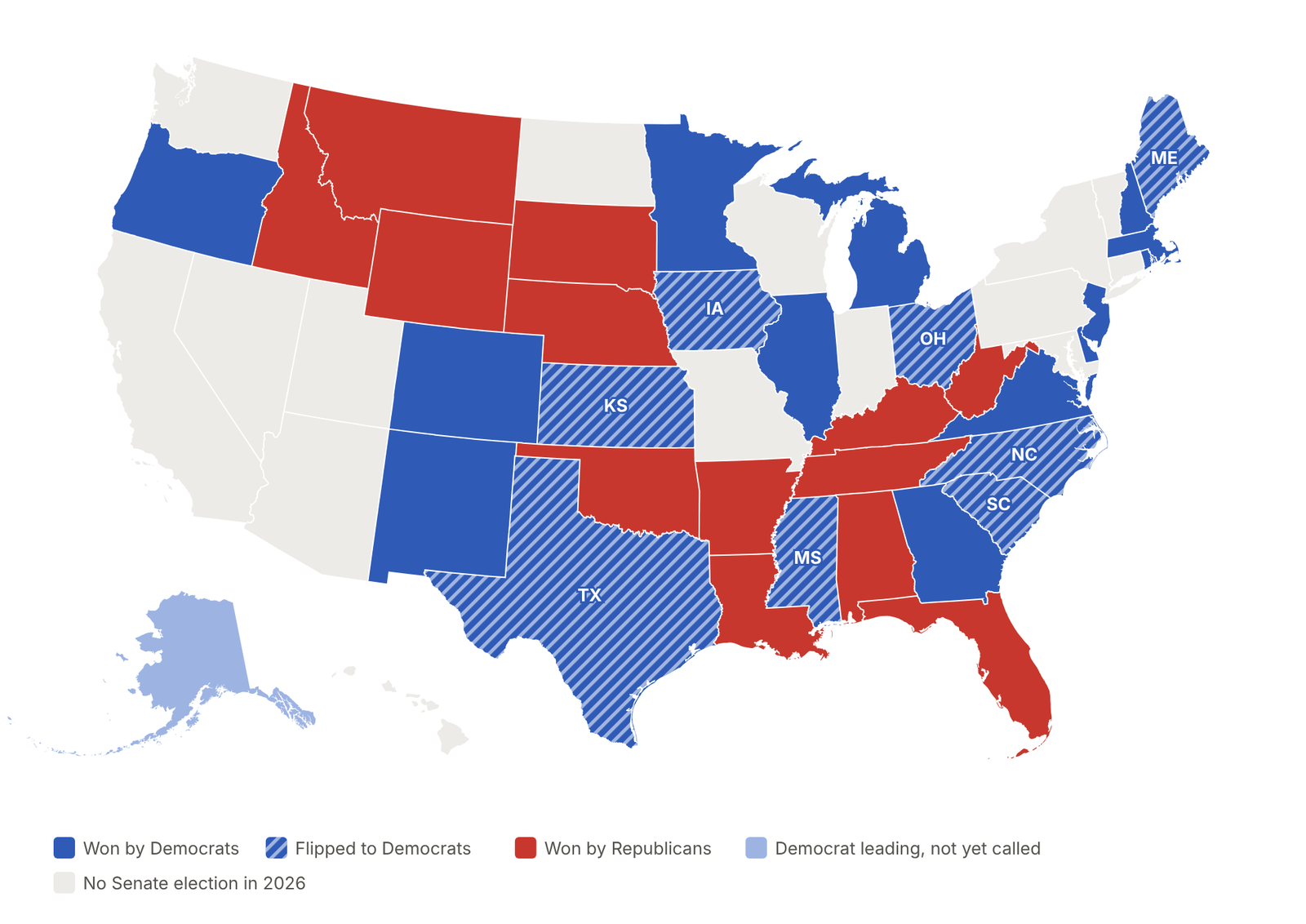
Exhibit 1: The 2026 Senate races. Democrats also won a majority in the House of Representatives. Source: SGMS, based on Associated Press results as of 15 November 2026. Alaska not yet called.
In short
- After all 19 midterms since 1950, the S&P 500 was higher a year later, by 15.1% on average. Who won made almost no difference.
- The sell-off was about data centres, not Congress in general. The real power to slow them sits with states like Texas, not Washington.
- For banks and crypto, the new Congress means hearings and subpoenas more than new laws. Any new law still needs the president’s signature.
Sell the news
The first reaction came before the votes were counted. At 10:24pm New York time on election night, CNBC reported Nasdaq-100 futures down 2% on fears that a Democratic Congress would slow the data centre build-out. By Wednesday morning the mood had flipped: a divided Washington means fewer big new laws, and markets like fewer surprises.
Thursday changed the story. Bernie Sanders had called for a “national data center moratorium now”, Texas’s Democratic governor-elect Gina Hinojosa had promised a freeze on new data centre approvals, and investors sold anything tied to AI. Nvidia had its worst day since January 2025, the Nasdaq fell into correction territory and the S&P 500 lost 4.4% in a single day.
Then the panic faded. By Wednesday 11 November the S&P 500 was back at 7,619, up 3.3% on the week and within 2.6% of its October record. Who bought the dip? According to Bank of America’s client data, big institutions bought $6.1 billion of US stocks in the week of the vote, while individual investors sold $2.1 billion. The professionals bought what the amateurs sold.
Nvidia itself had a rougher week. On 12 November its founder Jensen Huang resigned as CEO after a board investigation into his private life, and finance chief Colette Kress became interim CEO. That is a company story, not an election story, and we covered it in our Week 46 Market Recap. But it means the chipmaker at the centre of the AI trade now faces the data centre question without the man who built it.
Twelve months on
Our colleague Arnit Dey went back through every midterm since 1950 and measured what the S&P 500 did in the following twelve months. The result is striking: 19 midterms, 19 gains.
Exhibit 2
Twelve months on, nineteen times out of nineteen
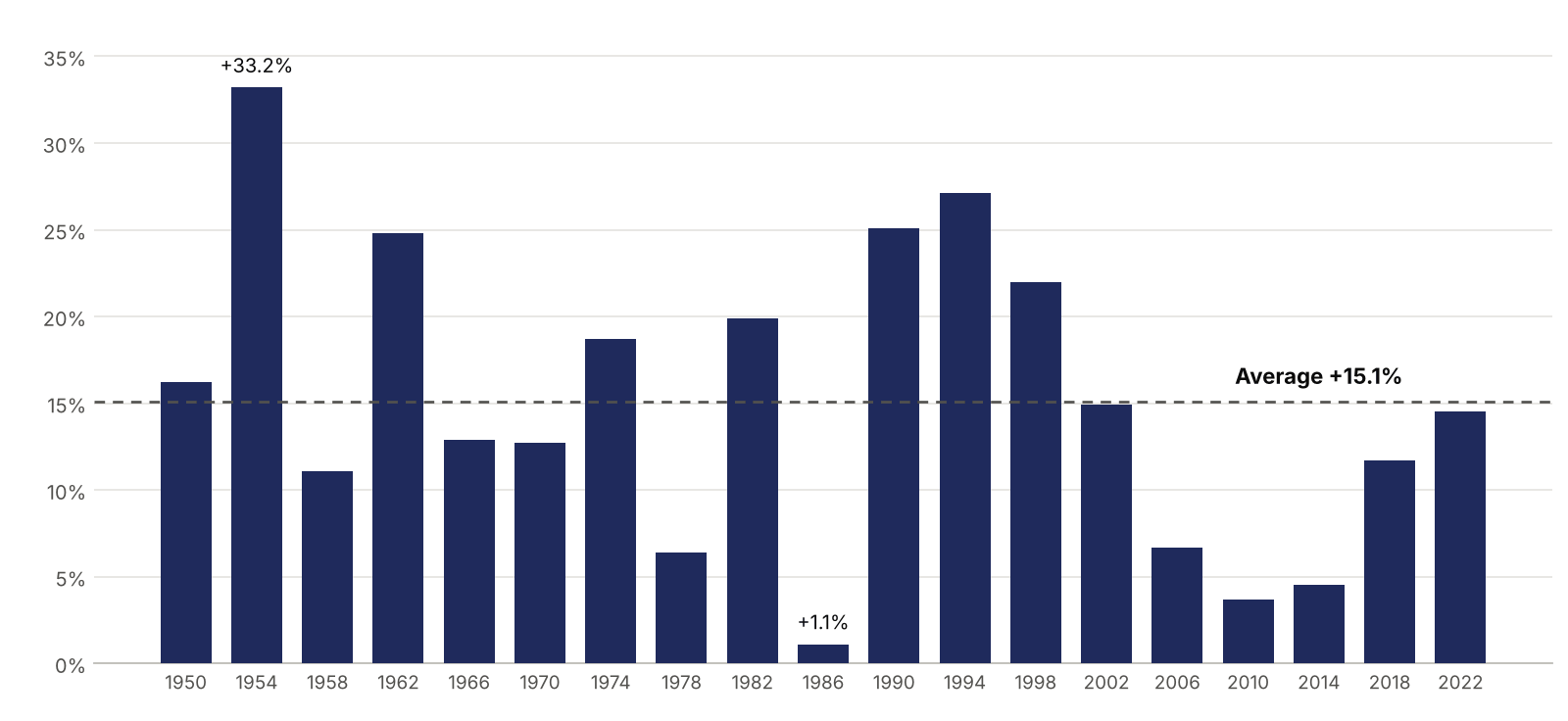
Exhibit 2: Twelve months on. S&P 500 price return in the 12 months after each midterm, 1950 to 2022, excluding dividends. Source: SGMS, based on Yahoo Finance (^GSPC) and AP. Data compiled by Arnit Dey.
The average gain was 15.1% and the median 14.5%. In plain words: $10,000 invested on the eve of an average midterm was worth about $11,500 a year later. Even the worst case, 1986, still ended up 1.1%, and that window includes the October 1987 crash.
Why? The usual explanation is the one markets reached for on Wednesday. Midterms usually take power away from the president’s party, which makes big new laws harder to pass. Less policy change means fewer surprises, and the uncertainty of the campaign is gone. There is a catch, though: the split does not explain the returns. Divided governments averaged 15.1% across 14 cases, unified Democratic ones 15.1% across 4, and the single unified Republican case, 2002, 14.9%. Whoever wins, the end of the uncertainty seems to matter more than the result.
Two words of caution. Nineteen elections is a small sample, and every one of them had its own story: rate cycles, recessions, a crash. This is a historical regularity, not a rule. And 2026 starts from an unusual place, with the S&P 500 near a record, a war with Iran and a Fed that raised rates in September.
Not in my backyard
The AI sell-off was the market’s real verdict on the election. As we wrote in Cloudy With a Chance of Default, the AI boom runs on data centres, and data centres run on borrowed money and cheap power. Anything that delays them hits the companies that sell them chips, from Nvidia to AMD.
But can Congress actually stop them? Not really. Sanders and Alexandria Ocasio-Cortez’s Artificial Intelligence Data Center Moratorium Act would pause new construction until Congress writes AI rules, but most bills need 60 votes in the Senate, and the president can veto anything that reaches his desk. The new Congress only takes office in January 2027. What it can do is hold hearings, call in executives and refuse to pass the single federal AI rule the White House wants, which would have overridden state laws.
That leaves the real power with the states. Texas accounts for about a quarter of planned US data centre capacity, according to Goldman Sachs, and it just elected a governor who promised a freeze. She takes office on 19 January. On election day, voters in 10 states also decided 41 local data centre questions, and sided against the data centres in 40 of them. For investors, the risk is less a national stop than a patchwork of local delays.
Checks and balance sheets
For banks, the new Congress means more questions, not new laws. Senator Elizabeth Warren, a long-time critic of Wall Street, is widely expected to chair the Senate Banking Committee, and Democratic senators have talked openly about subpoenas and investigations. Expect hearings on capital rules, bank mergers and credit card costs.
Hearings are not regulation, though. The agencies that write bank rules, like the FDIC and the OCC, are still run by people appointed by President Trump, and they have already relaxed capital rules and made mergers easier. As Citi’s Ben Gerlinger put it, Congress “can make life difficult” but “can’t necessarily change the overall tenor of where the banks are projected to go.” Investors seem to agree: in the week of the vote, Bank of America’s clients put one of the largest weekly sums in its data into financial stocks.
History is less kind. One study of 25 midterms since 1926 found that bank stocks beat the overall market in the following year only 10 times, trailing it by 4.3 percentage points on average. In the last five midterms, the main financials fund XLF lagged the S&P 500 every time.
Block party’s over
Crypto had the most to lose on election night. The industry spent heavily to elect friendlier lawmakers, and its main bill, the CLARITY Act, which would set clear rules for crypto markets, had already stalled in the Senate in September. Bitcoin fell to $75,618 overnight, a seven-week low, then recovered to about $79,200 on Wednesday morning, as most of the result had already been priced in.
It did not last. On Thursday, the tech sell-off spread to crypto: bitcoin fell back below $76,000 and Coinbase, whose profits depend on crypto trading, dropped 9%. Bitcoin ended the week down 2.0%, at about $75,900. The bigger change is political. A bill that is not passed before the new Congress arrives in January has to start again from scratch, and Democrats have said they will investigate President Trump’s own crypto businesses. For crypto, the next two years look more like investigations than legislation.
Our view: Historically, midterm elections have been followed by gains in the S&P 500, in all 19 cases since 1950. But the idea that gridlock itself is good for stocks is more Wall Street myth than statistics: divided and unified governments saw almost identical returns.
Gridlock watch
- Nvidia results, 17 November. The first report under interim CEO Colette Kress, and the first hard data on whether data centre orders are holding up after the vote.
- The Fed, 9 December. A rate hike is now widely expected. Higher rates weigh on exactly the borrowing that funds data centres.
- Texas, December. The state grid operator ERCOT is due to finish its data centre review. How the governor-elect would apply her freeze is still unclear.
- The new Congress, 3 January 2027. Committee chairs take over, and the first hearings show whether the target is AI, banks or the White House.
So is gridlock good? Good enough, just not for the reason Wall Street likes to give. Stocks have climbed after midterms because the uncertainty ends, not because Washington stops working. This time the risk for investors sits somewhere else: in state capitals and town halls deciding whether to plug in the next data centre. Congress can stay jammed for two years. The traffic that matters runs on the Texas grid. ■
Wall Street to English
| Term | What it means |
|---|---|
| Midterm election | The US vote held halfway through a president’s four-year term, for all House seats and about a third of the Senate. |
| Gridlock | When Congress and the president are from different parties and struggle to agree, so few new laws get passed. |
| Divided government | When at least one chamber of Congress is controlled by the party opposite the president. |
| Price return | The change in an index’s level, without the dividends that companies pay out. |
| Correction | A fall of 10% or more from a recent high. |
| Moratorium | A temporary ban, here on building or approving new data centres. |
| Veto | The president’s power to block a law passed by Congress. Overriding it takes two-thirds of both chambers. |
Sources
- SGMS, Market Recap Week 45: Blue Wave, Red Screens, 9 Nov 2026
- Arnit Dey for SGMS, S&P 500 in the 12 months after each midterm, 1950 to 2022, based on Yahoo Finance ^GSPC data via github.com/fja05680/dow-sp500-100-years
- Associated Press, Democrats win control of Congress in the midterm elections, 4 Nov 2026, with Senate results as of 15 Nov 2026
- Multibagg/CNBC, Will a Democratic Congress slow the AI data center boom?, 4 Nov 2026
- TheStreet Pro, BofA says big investors bought the dip while retail kept selling, 11 Nov 2026
- La Nación/AP, How major US stock indexes fared Wednesday, 11 Nov 2026
- NVIDIA, NVIDIA announces CEO transition (Form 8-K), 12 Nov 2026
- Political.org, Sanders and other Democrats call for national data center moratorium, 5 Nov 2026
- PolicySoup, H.R. 9442 Artificial Intelligence Data Center Moratorium Act
- Baxtel, Texas governor-elect pledges moratorium on new data center approvals (citing Goldman Sachs via Reuters), 5 Nov 2026
- Fox Business, Data centers were on the ballot, and voters sent unmistakable message (Ballotpedia and CNBC data), Nov 2026
- Fortune, Wall Street banks brace for Warren and a Democratic Congress, 7 Nov 2026
- American Banker, Democrats sweep Congress, setting up years of oversight for banks, 4 Nov 2026
- SimianX, Bank stocks after midterm elections: a 100-year reference table, Nov 2026
- Bitcoin Magazine, Bitcoin price soars above $79,000 after Democratic sweep of Congress, 4 Nov 2026
- Crypto Briefing, Democrats take Congress in a midterm that resets crypto’s path in Washington, Nov 2026
- TIKR, Coinbase sinks 9% as bitcoin falls below $76,000, 5 Nov 2026
- Bankless, Crypto holds steady as Democrats sweep Congress, 4 Nov 2026
