

By Caitlyn Fischli
For years, investors worried that artificial intelligence might replace humans. This week, Nvidia reminded Wall Street that humans remain perfectly capable of destroying billions in market value without any help from AI. Jensen Huang’s spectacular exit turned the world’s favourite chipmaker into a corporate soap opera, leaving investors to reconsider whether their portfolios were perhaps a little too dependent on one man in a leather jacket.
Meanwhile, the S&P 500 somehow finished higher, suggesting that Wall Street’s preferred response to bad news remains buying something else. Inflation kept the Fed hawkish, bond yields climbed, and the dollar strengthened as borrowing money became increasingly expensive. Gold discovered that safe havens aren’t always safe, oil traders traded fears of scarcity for fears of abundance, and Bitcoin reminded everyone that decentralisation does not extend to avoiding a sell-off.
In short, the AI revolution lost its leading man, the Fed kept playing the villain, and markets continued to insist this was all perfectly normal. At least Netflix has material for another season.
Equities & Deals
By Luzius Richter
The big one. On Tuesday, Anthropic, the maker of Claude, set the terms for its Nasdaq listing: 825m shares at $70 to $78 each, under the ticker ANT. That values the company at between about $1trn and $1.4trn. At the midpoint, the base offering raises about $61bn, second only to SpaceX’s $75bn IPO in June. With the extra shares the banks can sell if demand is strong (the greenshoe) and a $26bn private placement from companies including Nvidia and Google, the total could approach $100bn. Despite the AI swings of the last two weeks, the order book is reportedly several times oversubscribed ahead of pricing on 18 November. The risks are real, though: Nvidia shares fell as much as 14% on Thursday after Jensen Huang resigned as chief executive amid allegations of multiple affairs, one with an alleged Chinese spy.
MediaMarkt, now made in China. JD.com completed its takeover of Ceconomy, the parent of MediaMarkt and Saturn, on Thursday. The Chinese e-commerce group paid €4.60 a share in cash, or €1.3bn for 59.8%. The Kellerhals family, MediaMarkt’s founders, keeps 25.3% through its holding company Convergenta, so the two partners own about 85% together. The last hurdle fell on 3 November, when Brussels approved the deal. JD.com gets more than 1,000 stores in 11 countries, 50,000 employees and €23.1bn in annual revenue. Ceconomy will stay a stand-alone European business, with no changes planned to jobs or sites. Where Amazon built warehouses, JD.com simply bought the shop floor.
Macro & Rates
By Marie-Lisa Ture and Rasesh Rathi
United States. Prices in the US rose 0.4% in October, according to Tuesday’s CPI report, above the 0.3% economists expected. Core inflation, which leaves out food and energy, rose 0.3%, also above its 0.2% forecast. As it was the last inflation report before the Fed’s decision on 9 December, markets now see another rate hike as almost certain. The two-year Treasury yield jumped to 4.70%, the franc fell against the dollar, and the only question left is whether the Fed raises by 0.25 or 0.5 points.
Japan. The Bank of Japan kept rates at 1.25% in October, but notes from that meeting, published on Tuesday, show a board itching to raise them again. Most members agreed the next move is up, and some even called for moving faster. With wages rising at their fastest pace in almost 30 years, a December hike looks likely. The yen hardly moved, staying near 158 per dollar, and if the Fed hikes too it may not budge, since the gap between US and Japanese rates would stay the same. The US-Japan rate battle ends 1-1.
Jittery. Oil slid early in the week on hopes of a deal to end the war, after Trump spoke of “positive momentum” following a meeting with Qatar’s prime minister. Attacks on tankers in the Strait of Hormuz kept things far from calm, though. In the US, core prices, which leave out food and energy, rose 0.3% for a third straight month. That matters because core prices are what the Fed watches most closely, and traders now see a December rate hike as more likely.
By Arnit Dey
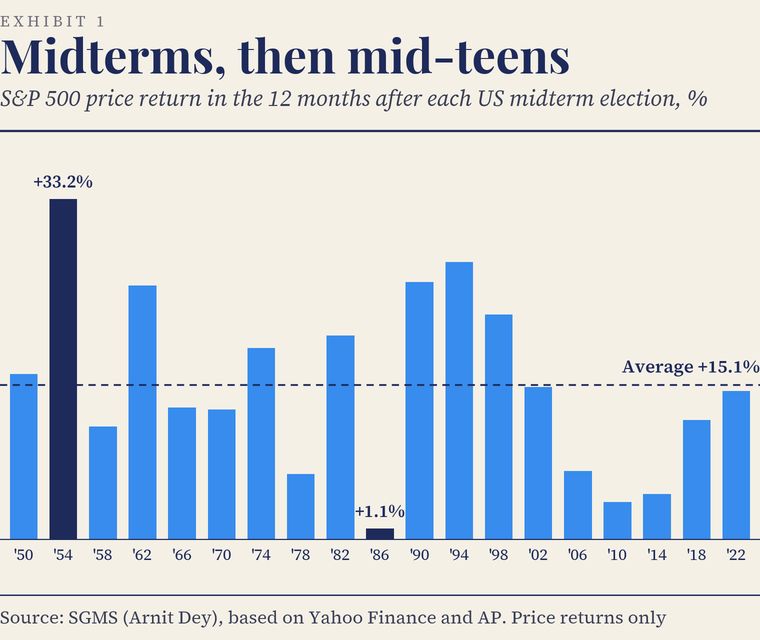
Midterm maths. With Democrats set to run Congress, here is some history. Since 1950, the S&P 500 has been higher 12 months after all 19 midterm elections, with an average gain of 15.1% (Exhibit 1). Even the weakest year, 1986, ended up 1.1%, despite the October 1987 crash. Who wins barely matters: divided governments averaged +15.1%, exactly like unified Democratic ones. Nineteen elections is a small sample, though, and each came with its own story of rates and recessions. A pattern, not a promise.
Commodities & Alternatives
By Balthazar Monchau
Gold. Last week’s party had a hangover. Gold fell about 4.5% to $3,884 an ounce, its worst week since June, and on Thursday it hit its lowest level in more than a year. The trigger was US inflation: prices rose 0.4% in October against 0.3% expected, and Fed officials lined up to promise more hikes. Markets now price a December hike as a sure thing. Gold pays no interest, so that’s bad news. Silver had it worse, at a one-year low.
Oil. The market has switched worries. For eight months traders feared there wouldn’t be enough oil; now they fear there’s too much. On Friday the International Energy Agency (IEA) forecast a surplus of 1.7 million barrels a day this quarter, the first since the war began. Brent slipped 2.0% on the week to $95.84, its second weekly loss in a row. Iran’s claims that tankers hit mines in the Strait of Hormuz, still unconfirmed, barely moved the price.
The week in numbers
By Jiaji Xie
| Market | Close | Week |
|---|---|---|
| S&P 500 | 7,561.67 | +2.5% |
| Nasdaq | 25,136.27 | +2.3% |
| SMI | 15,106.12 | +2.1% |
| Stoxx Europe 600 | 664.14 | over +2% |
| Dow Jones | 52,347.55 | +2.1% |
| Brent oil | $95.84 | −2.0% |
| US 10-year yield | 5.15% | +0.29 pts |
| Bitcoin | about $68,200 | −10.1% |
Friday 13 November close, change on the week. Sources: Yahoo Finance, Reuters, MarketScreener, The Closing Print
Beginner corner: Futures
By Lucius Küng
A future is a contract to buy or sell something on a fixed date, at a price agreed today. Oil, wheat, gold and even stock indices trade this way. An airline can lock in next year’s fuel cost, and a farmer can lock in the price of a harvest before it has even grown. The Brent price in this recap is a futures price, for delivery in January. The catch: most traders never want a single real barrel, so they close the contract before it expires.
Next week
By Hugo Benoit
| Mon 16 | Japan’s growth figures for July to September |
| Tue 17 | US retail sales for October and Home Depot results. The big one after the US close: Nvidia’s first results since Huang left. In St. Gallen, our CLO evening with Alegra Capital at 18:15 |
| Wed 18 | Fed minutes, UK inflation, Target and TJX results. Anthropic is due to price its IPO |
| Thu 19 | Walmart results before the US open, US weekly jobless claims |
| Fri 20 | Flash business surveys (PMIs) for the eurozone, the UK and the US |
That’s it for this week. Nvidia reports on Tuesday without Jensen Huang, so get the popcorn ready. See you next Monday,
Hugo Benoit
Head of Market Research, St. Gallen Markets Society
with the analysts of the SGMS Market Research team
Written by students for education. This is not investment advice.